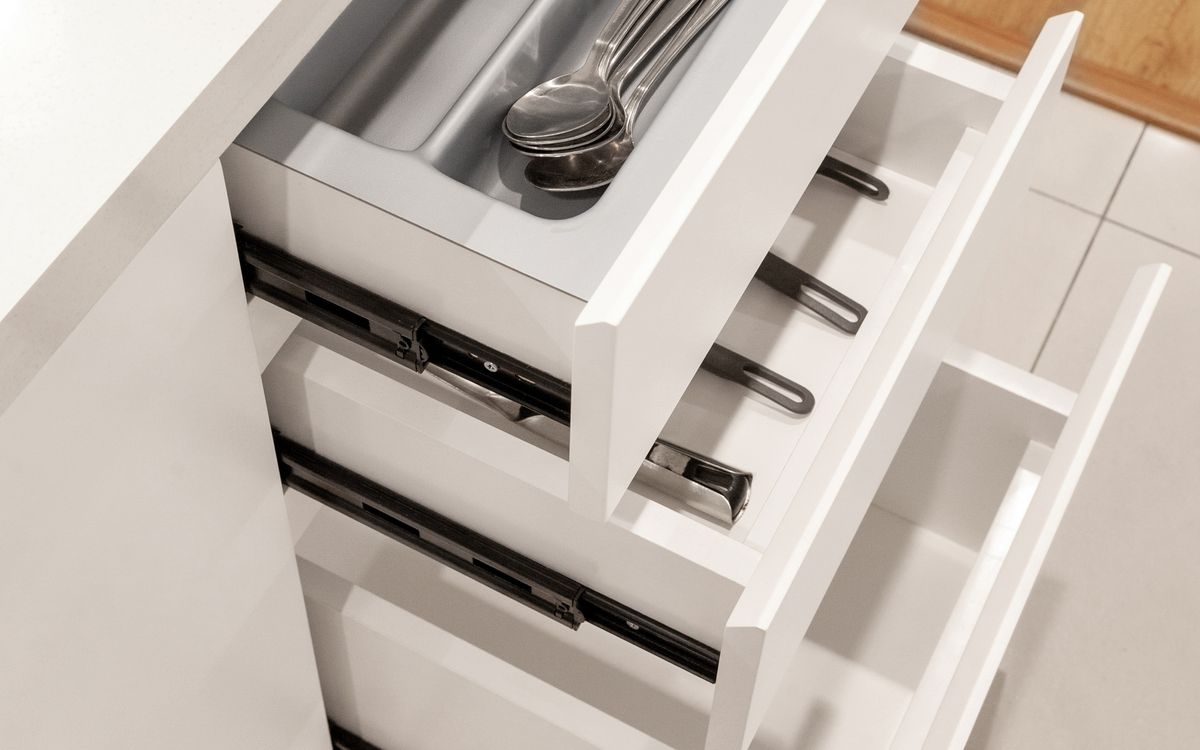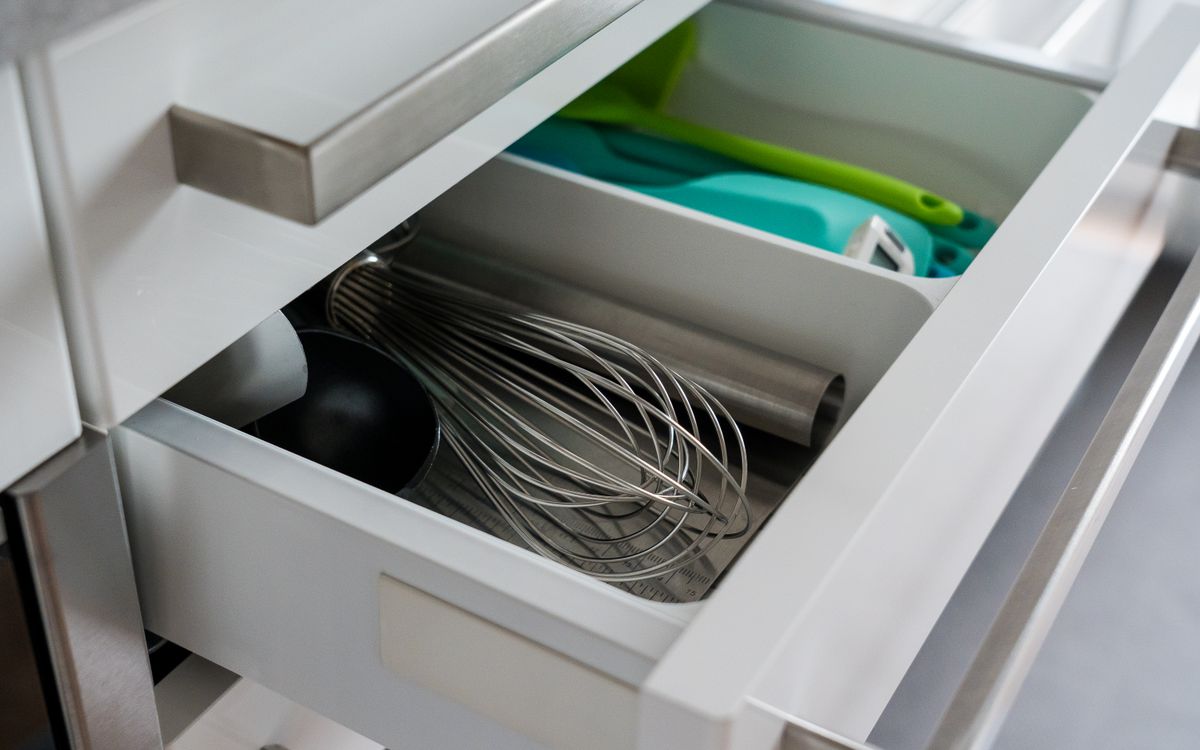
A deep drawer is two problems in one box. It is deep front to back, which means things slide toward the back and stay there, and it is deep top to bottom, which means a 2-inch divider tray disappears into the bottom eighth of it.
The three divider types sold for this situation solve different halves of that. What they have in common is that all of them are quoted against a drawer’s nominal size, and none of them is quoted against the number you can actually measure once the slides and the drawer sides have taken their share.
Deep is two dimensions, not one
Kitchen drawers are described by one number, usually the cabinet width: an 18-inch drawer, a 24-inch drawer, a 30-inch drawer. That number is the cabinet opening, not the drawer.
Inside that opening there are two deductions before you reach anything a divider touches. The slides take about 1/2 inch on each side, so the drawer box is an inch narrower than the opening. The drawer sides take another 1/2 inch each. What is left is the interior, and it is usually 2 inches less than the number on the cabinet.
The depth direction has its own deductions: a front panel and a back panel, which together cost about 1 to 1 1/4 inches. So an 18-inch-deep drawer box gives you about 16 3/4 inches of interior depth to work with.
Both numbers matter because dividers can run either way. A board that spans the width makes lanes front to back. A board that spans the depth makes lanes side to side. Most people want the first and most manufacturers size for the second.
The 18-inch drawer, worked through
Take the most common narrow base cabinet: an 18-inch opening with an 18-inch-deep drawer box.
The interior width is 18 minus 1 inch for the slides minus 1 inch for the two drawer sides, which is 16 inches. The interior depth is 18 minus 1 1/4 inches for the front and back panels, which is 16 3/4 inches.
Now put the three divider types against those figures.
A spring-loaded divider that spans 17 3/8 to 22 inches cannot span 16 inches. It will not grip, and there is no adjustment that fixes it, because the spring needs to be compressed to hold. A set of these in an 18-inch drawer fails at the first board.
A bamboo tray 17 1/2 inches long needs 17 1/2 inches of interior depth and has 16 3/4. It overhangs by 3/4 inch and the drawer will not close flush.
A trimmable peg board sized for a 30-inch drawer can be cut down to 16 inches, which is the only one of the three that survives the measurement, and it survives at the cost of half the board and most of the peg holes.
That is the honest summary of the category: an 18-inch drawer is the worst case for off-the-shelf dividers, and the products that work in it are the ones you can cut.
Adjustable dividers: spring tension and a hard minimum
The Lipper International 8897 Bamboo Wood Custom Fit Adjustable Deep Kitchen Drawer Dividers are the reference product for this type. Two boards per set, each 3/4 inch thick and 5 inches tall in the deep version, with internal springs that press the ends against the drawer walls.
The published range is 17 3/8 to 22 inches. That range tells you what the product is for: a drawer 20 to 24 inches wide, which is the common width of a base cabinet drawer. In a 22-inch interior it sits near the top of its range and needs compressing by hand to seat. In a 24-inch interior it sits at the maximum and will hold, but with no margin for a drawer that is out of square.
The 5-inch height is the other half of the specification and the reason this is a deep-drawer product rather than a cutlery one. The same maker sells a regular version about half that height, which is for a shallow utensil drawer. In a 9-inch-deep drawer, a board that low stops nothing: plates lean over it, chopping boards slide across it, and the lanes stop being lanes.
Bamboo is the material for a reason that has nothing to do with looks. A tension divider needs stiffness along its length, and bamboo is stiff per unit of thickness, which is why a 3/4-inch board can hold a lane of cast iron without bowing. It also does not absorb water the way an unsealed softwood board does, which matters in a drawer under a worktop where a wet pan gets put away.
The limitation is that a tension fit is only as good as the drawer’s squareness. In a box that is 1/4 inch out of square, which is ordinary in older cabinets, the board grips on one end and rattles on the other, and the fix is a shim rather than an adjustment.
Fixed inserts: trim once and commit
The Rev-A-Shelf 4DPS-3021 Trimmable Pegboard Drawer Organizer takes the opposite approach. It is a 30 1/4 by 21 1/4 inch maple board, 6 5/8 inches high including the pegs, with 12 wooden pegs that drop into a grid of holes.
Nothing about it is adjustable once it is in place, which is the point. The board is cut to the drawer with a table saw and dropped in, and the pegs are then positioned around whatever is being stored: plates on edge, pans stacked, lids in a row. Rev-A-Shelf recommends it for drawers 8 inches deep or more, which is the definition of the deep drawer this piece is about.
The 6 5/8-inch height is what makes it work for plates. A peg board does not separate items with walls; it stops them sliding by putting a peg on either side, so the height of the peg is the height of the barrier. At 6 5/8 inches it holds a dinner plate on edge with the top third exposed, which is what you want when you are reaching in with one hand.
The trade is commitment. The board is sold in 24, 30 and 39-inch widths precisely because it is meant to be cut down to fit, but cutting a 30-inch board to 16 inches removes most of the peg field and leaves a narrow strip of usable grid. If your drawer is 18 inches wide, you are buying a 30-inch board to use half of it, and the arithmetic on that is poor.
At around $74 for the 30-inch board, that is an expensive way to organize a small drawer. It is a fair price for a 30-inch drawer full of plates.
Bamboo trays: three to five slots and a footprint
The Purawood Bamboo Kitchen Drawer Organizer is the third type: a tray with fixed compartments, in this case a range that expands from three slots at 13.7 inches wide to five slots at 20 inches.
The dimensions are 17 1/2 inches long and 2 inches deep, which places it firmly in the shallow-tray category. Purawood’s own guidance is that it suits a drawer of at least 18 by 20 inches, and that guidance is the whole story: 17 1/2 inches of length plus clearance needs a 20-inch drawer depth, and the expanding width means the tray wants 20 inches in the other direction to reach its five-slot size.
Set against the 18-inch drawer, it misses on both counts. Set against a 24-inch drawer, it fits and does a specific job well: cutlery, utensils, small gadgets, the things that want a slot rather than a lane.
What it does not do is use the height. At 2 inches deep in a 9-inch drawer, it organizes the bottom 22 percent of the volume and leaves the rest empty. That is not a fault in the product; it is a fault in buying a shallow tray for a deep drawer and expecting the whole drawer to be organized.
What the three cost in usable width
| Product | Type | Published span | Fits a 16-inch interior? | Height |
|---|---|---|---|---|
| Lipper International 8897 | Spring divider | 17 3/8 to 22 in | No, 1 3/8 in short | 5 in |
| Rev-A-Shelf 4DPS-3021 | Trimmable peg board | 30 1/4 in, cut to fit | Yes, with loss of peg field | 6 5/8 in |
| Purawood Bamboo Kitchen Drawer Organizer | Expanding tray | 13.7 to 20 in wide, 17 1/2 in long | Only if the drawer is 20 in deep | 2 in |
The column that decides it is the fourth one, and it is the column no listing shows. Every product here publishes a size; none publishes the interior it needs after slides and side panels. That gap is why drawer dividers get returned more than almost anything else in the category.
The rule that follows is simple enough to apply in a shop: measure the inside of the drawer, subtract nothing else, and compare that figure to the published span. If the drawer measures 16 inches and the divider starts at 17 3/8, the answer is no, regardless of what the cabinet is called.
Height: the zone above the divider
A deep drawer’s upper half is a separate storage zone, and dividers mostly ignore it.
The three products here are 2, 5 and 6 5/8 inches tall. In a 9-inch drawer, that leaves 7, 4 and 2 3/8 inches of unused height respectively. For plates stored on edge, the peg board’s 6 5/8 inches is close to ideal. For a drawer holding pots, even 6 5/8 inches is a low wall, and the pans stack above it rather than beside it.
Two ways to use the upper zone without buying anything else. The first is to store flat things on top: lids, silicone mats, a stack of tea towels, all of which sit above the dividers and below the worktop. The second is a second shallow tray on a riser, which turns one deep drawer into two shallow ones and costs the height of the riser.
What does not work is a tall divider in a deep drawer used for heavy items. A 5-inch bamboo board under a stack of cast iron bows, and a bowed board stops separating anything.
The shortlist
For a drawer 20 to 24 inches wide holding plates or pans, the Lipper International 8897 Bamboo Wood Custom Fit Adjustable Deep Kitchen Drawer Dividers are the ones to buy. The 5-inch height is right for a deep drawer, the tension fit needs no tools, and the 17 3/8-inch minimum is the number to check before anything else.
For a wide drawer where the layout should not move again, the Rev-A-Shelf 4DPS-3021 Trimmable Pegboard Drawer Organizer is the better answer. It is the only product here that handles plates on edge properly, and the trim-to-fit design means it will sit in a drawer that is slightly out of square.
For the 18-inch drawer, none of the three is a clean fit, and the honest recommendation is to trim the peg board down or to accept a smaller tray and use two of them side by side. The Purawood Bamboo Kitchen Drawer Organizer is the one to consider for a 24-inch drawer that needs cutlery slots rather than lanes.
Whichever you choose, measure the inside of the drawer box in both directions before buying, and write both numbers down. The measurement routine is set out in how to measure a cabinet for inserts, the vertical version of the same problem is in shelf risers and stacking, and if the drawer in question is a pantry drawer, pantry shelf depth covers the depth arithmetic.