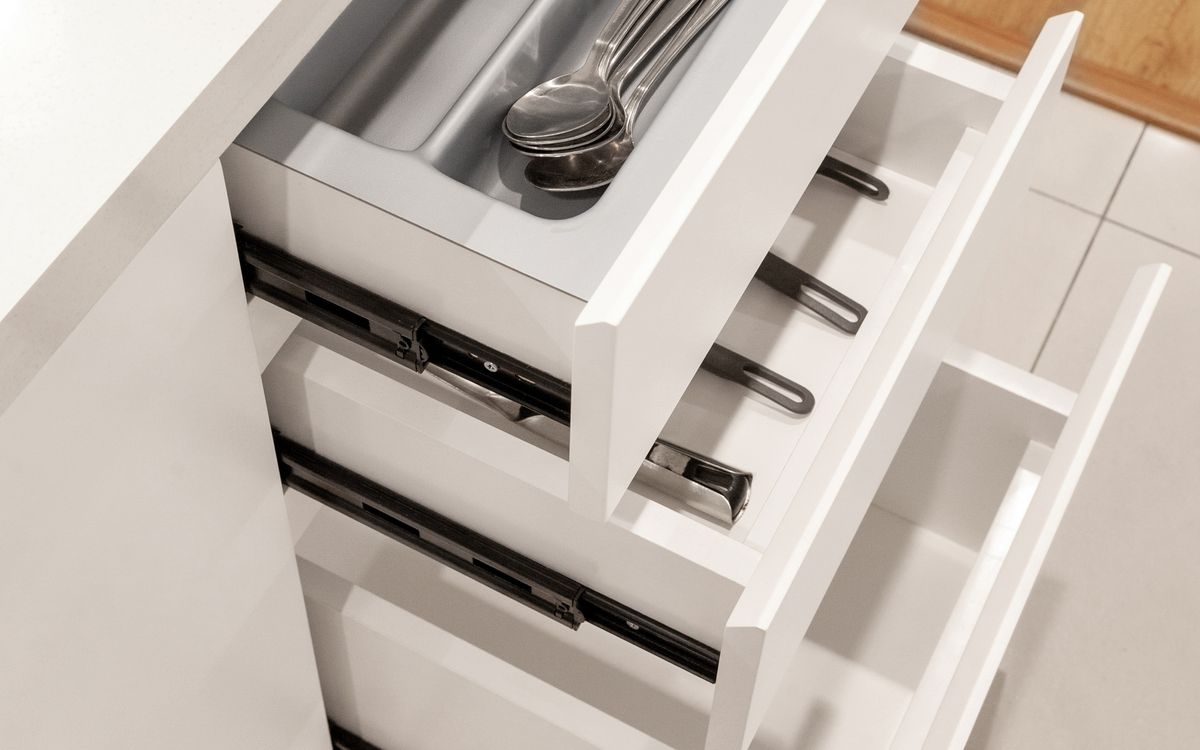
The inside of a pantry door is the last free surface in the kitchen. It is already there, it already swings, and it holds nothing. A rack on it is the cheapest shelf you will ever add — until the door starts to drop at the latch side, which is the point at which people discover that a door is a panel hung on two small pieces of hardware, not a wall.
Three numbers decide what a door rack can hold: the hinge type and how much board is left behind the hinge cup, the thickness and construction of the door panel, and the depth of the rack relative to the door’s swing.
A door is a panel on two screws, and the screws sit in 5 mm of board
Almost every modern cabinet door hangs on concealed cup hinges. The hinge is set into a 35 mm hole bored 13 mm deep into the back of the door, and the hinge plate screws to the cabinet side.
In an 18 mm door — the most common thickness in North American cabinets — a 13 mm bore leaves 5 mm of material behind the cup. That 5 mm is what holds the door up. It is also why a door that has been overloaded fails at the cup rather than at the hinge: the screws holding the cup to the door wallow out the hole, the door drops a few millimetres, and the latch stops meeting the catch.
Anything you hang on the door adds to the load those cups carry, and it adds it at a distance. That is the key point, and it is covered by the arithmetic further down.
Three hinge types and what each one does with extra weight
Concealed cup hinges are the default. They are adjustable in two or three axes, they open to 100, 110 or 125 degrees, and they are matched to the door weight by the cabinet maker rather than by you. Two hinges on a full-height pantry door is normal; three on a door over about 40 inches tall.
Butt and knife hinges appear on older cabinets and on inset doors. They carry load through the door’s edge rather than its face, which is stronger per hinge but offers no adjustment. A door on butt hinges that has dropped is harder to correct.
Piano hinges run the full height of the door and distribute load along the whole edge. They are the strongest of the three for a heavy door and the least forgiving of a cabinet that is out of square.
None of these hinges is rated for “door plus contents”. The rating, where one is published at all, is a door weight, and the door’s own weight is already most of it. A 24 by 60 inch door in 18 mm MDF weighs roughly 30 pounds; two hinges made for that door have very little headroom left.
Door thickness and the half-inch screw
Door thickness runs from 16 mm to 22 mm, or about 5/8 to 7/8 inch. Eighteen millimetres, or 3/4 inch, is the working default.
That figure sets the screw. A 5/8-inch screw into an 18 mm door leaves the point about 1/16 inch from the front face; one hard turn and it lifts the finish. A 1/2-inch screw is the safe length for door-face fixings, and a 3/8-inch screw is the safe length where the fixing sits over a thin raised-panel field.
The construction matters more than the thickness.
A slab door is one solid panel, usually MDF or particleboard with a laminate or veneer. It takes a screw anywhere except within about 1.5 inches of the edge, where the panel is weakest.
A five-piece door has a frame of stiles and rails around a thinner centre panel. The frame is typically 2 to 2.25 inches wide and is where the structure is; the centre panel is often only 1/4 inch thick and cannot carry anything. Fix the rack to the stiles and rails and let the panel be.
A hollow-core door has skins about 1/8 inch thick over a cardboard honeycomb. Nothing can be fixed to it. This door cannot take a rack at all, and no anchor changes that.
Rack depth: the number the door swing sets
Rack depth is a three-way compromise between what fits on the rack, what the door can carry, and what the door needs to close.
Start at the closed position. Measure from the inside face of the door to the front edge of the nearest shelf inside the pantry, then subtract 1 inch. That is your maximum rack depth, including the cans standing on it. A standard pantry with 11 to 12 inches of usable depth, and shelves that stop an inch short of the door, gives a 4-inch rack with room to spare.
Then check the swing. A full-overlay door on a 110-degree hinge projects its own thickness plus the rack depth past the cabinet face when fully open, and its outer edge travels further than that. A 15-inch-wide door opening 110 degrees needs roughly 14 inches of clear space in front of the cabinet to open without contacting an adjacent wall, a fridge or a door frame. A rack on the door does not change that number; it changes what the door hits when it gets there.
Finally, check the hinge side. A rack that runs the full width of the door will foul the hinge arms as the door closes past about 30 degrees. Leave 2 inches clear at the hinge edge on a concealed-hinge door, and check the clearance by closing the door slowly with the rack empty before you load it.
How much weight a door rack can take
The load on a hinge is not the weight on the rack; it is the weight multiplied by its distance from the hinge axis. That product is a torque, and it is what the screws feel.
Take a 15-inch-wide door with a three-tier rack holding six cans per tier. Eighteen cans at roughly a pound each is 18 pounds, and the rack’s centre of mass sits about 7.5 inches from the hinge. That is 135 pound-inches of torque on two hinges, or about 68 pound-inches per hinge, hanging on two screws in 5 mm of board.
Put the same 18 pounds on a 24-inch-wide door and the centre of mass moves to 12 inches from the hinge: 216 pound-inches, a 60 percent increase for the same weight. This is why a wide door sags before a narrow one does, and why the fix for a sagging door is usually to move the heavy items to the hinge side rather than to add a third hinge.
The practical rule: keep a door rack under about 15 pounds, put the heaviest items at the bottom tier and toward the hinge, and do not put glass jars, bottles of oil or a 5-pound bag of rice on a door at all.
Mount to the frame, never the panel
Every rack fixing should land on structure. On a five-piece door that means the stiles and rails. On a slab door it means anywhere but the outer 1.5 inches. On an 18 mm door it means a 1/2-inch screw, four per rack, with the top pair as high as the rack allows.
If the door is thin, or the rack is heavier than 15 pounds, through-bolt it. A machine screw through the door with a washer and a cap on the outside face is stronger than any wood screw, and the cap reads as a design detail rather than a repair. The cost is a visible fastener on the front of the door, which is why it suits a painted pantry rather than a veneered one.
Then test before loading. Open the door to full extension, let it hang, and look at the gap between the door and the cabinet side at the top. If the gap closes when the rack is empty, the hinges are already at their limit and the rack should go elsewhere.
When the rack belongs on the wall instead
A door rack is the wrong choice for a door that is narrower than 12 inches, a door on a cabinet that also has pull-out shelves behind it — the two systems collide in the same 4 inches of air — or a door that is hollow, thin or already sagging.
In those cases the same volume is available on the wall beside the pantry, or on the end panel of the cabinet run, where the fixing goes into a stud rather than into a hinge. It is less convenient and it holds more, which is usually the right trade for anything heavier than a box of crackers.
For the shelf side of the same cabinet, pull-out pantry shelves covers the slide ratings and the panel thickness that decide a load. If the clutter on the door is mostly lids rather than cans, lid storage works through the three ways to keep them. And container sizes is the place to start if the door rack is meant to hold the containers themselves.