Most pantry advice starts with the shelf you already own and works backwards toward what will fit on it. This works the other way. A can, a box and a jar each consume a fixed amount of front-to-back space, and a shelf depth either accommodates a whole number of them or leaves a remainder that belongs to nobody.
Five depths are worth considering: 10, 12, 14, 16 and 20 inches. The rest of this piece is the arithmetic that decides which one you want, starting with the item that fills more pantry shelves than any other.
The five depths, and the rows they buy
Depth is a count, not a measurement. Once you know how wide the things you buy are, a shelf depth converts into a number of rows front to back, and that number is what you are actually choosing between.
| Usable depth | 15 oz cans | 28 oz cans | #10 cans | What it suits |
|---|---|---|---|---|
| 10 in | 3 rows (9 9/16 in) | 2 rows (8 1/8 in) | 1 row | A shallow closet or a wall cabinet |
| 12 in | 3 rows | 2 rows | 1 row | The default pantry shelf |
| 14 in | 4 rows (12 3/4 in) | 3 rows (12 3/16 in) | 2 rows (12 3/8 in) | Stock plus the odd large can |
| 16 in | 5 rows (15 15/16 in) | 3 rows | 2 rows | Bulk buying, backstock |
| 20 in | 6 rows (19 1/8 in) | 4 rows (16 1/4 in) | 3 rows (18 9/16 in) | Two zones, one of them a compromise |
The depths in that table are usable figures, measured after the back panel and the face-frame lip rather than off the showroom card; the deductions are set out further down. Two things in it are worth pausing on. The first is that 12 inches buys no more can rows than 10 inches does, because the fourth row needs 12 3/4 inches. The extra two inches go to jars, boxes and air, not to cans. The second is that the jump from 12 to 14 inches adds a whole row, and the jump from 14 to 16 adds another. Depth pays in steps, not in a straight line.
What a standard can costs in depth
The 15 oz can, called a #303 in the can industry’s code, measures 3 3/16 inches across and 4 7/16 inches tall. The code reads as inches and sixteenths, so 303 means three and three sixteenths of an inch in diameter, and the second number, in a full code like 303 × 406, gives the height.
That 3 3/16 figure is the unit of pantry planning. A row of cans is a row of 3 3/16-inch circles, so the depth they occupy is simply the diameter multiplied by the number of rows:
- three rows: 9 9/16 inches
- four rows: 12 3/4 inches
- five rows: 15 15/16 inches
- six rows: 19 1/8 inches
The same arithmetic applies sideways. A 15-inch-wide shelf bay holds four cans across with 12 3/4 inches used and 2 1/4 inches spare, and a 24-inch bay holds seven. A can sits inside a square cell for planning purposes, which is why the ninth and tenth cans in a row always seem to need more shelf than the first eight.
Height runs on a separate budget. A 15 oz can is 4 7/16 inches tall, so a 10-inch clear gap takes two tiers of cans with an inch to spare, and a 9-inch gap takes one. Stacking cans two high doubles the count on a shelf without touching the depth question, which is why the tier decision usually comes before the depth decision.
The cereal box is a height problem, not a depth problem
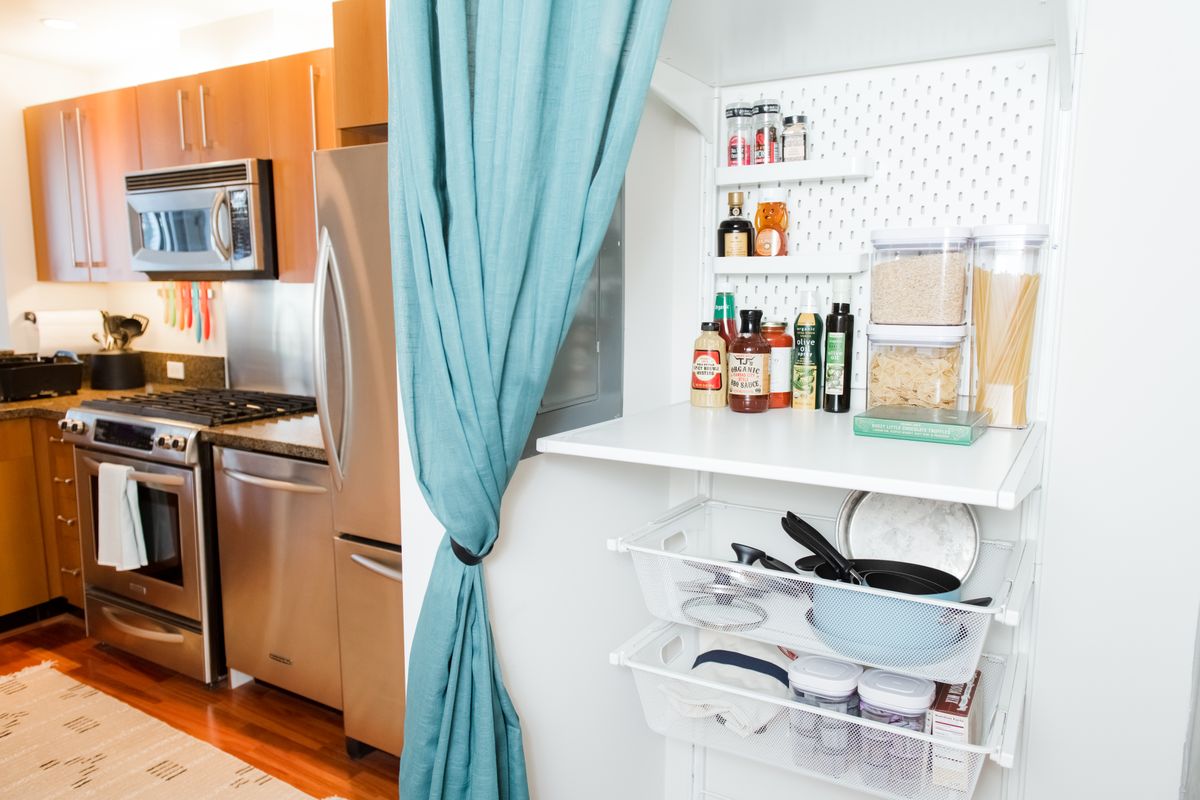
A standard cereal box is about 12 inches tall, 8 inches wide and 2 1/2 inches deep. In depth terms it is the cheapest item in the pantry: at 2 1/2 inches thick, even a 10-inch shelf takes it with 7 1/2 inches left over.
The cost lands on height. A 12-inch box needs a clear gap of 12 1/2 inches to lift in and out, and most pantry shelves are set at 10 to 12 inches, so the box goes in at an angle, the top corner catches the shelf above, and the cereal migrates to the counter. A family-size box is worse at 15 to 16 inches tall and 3 inches deep.
What this means for depth is narrower than it sounds. If cereal is a large part of what you store, the useful move is not a deeper shelf but one taller bay: a 14-inch clear gap and a 12-inch depth will hold four boxes face out in a 32-inch-wide run, because the 8-inch width and the 2 1/2-inch depth are what the boxes consume. Adding depth to that shelf buys nothing for cereal at all.
The one exception is a box stored lying down, which needs 12 inches of depth to sit flat. That is the only configuration where a 12-inch shelf and a cereal box interact, and it is also the configuration that makes the box hardest to read.
The 14-inch shelf, where the second large can fits
Fourteen inches is the first depth at which a #10 can goes two rows deep. That can is 6 3/16 inches across and 7 inches tall, and two rows need 12 3/8 inches, so it fits a 14-inch shelf with 1 5/8 inches to spare. On a 12-inch shelf the same two rows need 12 3/8 inches and do not go in.
It is also the depth at which 28 oz cans, the 4 1/16-inch size sold as crushed tomatoes and sliced fruit, reach three rows at 12 3/16 inches. Two rows of those on a 12-inch shelf leave 3 7/8 inches idle behind them, which is the width of one more can that will never fit.
The reason 14 inches is worth naming separately is that it is the smallest depth that behaves like a pantry rather than a cupboard. A 12-inch shelf is a row of what you use this week. A 14-inch shelf is a row of what you use this week plus a row behind it, which is the beginning of stock.
The 20-inch shelf is two shelves in a trench coat
A 20-inch shelf holds six rows of cans, and nobody reaches the sixth. The forearm is the constraint here, not the shelf: the front four rows are reachable from a standing position and the back two are a decision you make once a season.
The usable version of a 20-inch shelf is two zones with different rules. The front 10 to 12 inches holds everything in daily rotation and nothing goes in front of anything else. The back 6 to 8 inches holds stock in containers that come out as a unit, which means a small number of large bins rather than a shelf of small items.
Counted in cans, that back zone holds two of the six rows, about a third of the shelf area, and it should hold well under a third of the items. If it holds more, the shelf is not deep, it is full, and the front rows are being unloaded every time somebody wants a tin of tomatoes from the back.
Nominal, inside and usable are three different numbers
A shelf sold as 12 inches deep does not give you 12 inches to fill. Three deductions sit between the number on the plan and the number on your tape.
Nominal depth is the cabinet’s outside depth. Inside depth is nominal minus the back panel, which is usually 3/4 inch on a cabinet box and can be 1/4 inch on a flat-pack pantry. Usable depth is inside depth minus the face-frame lip, 3/8 inch on a typical framed cabinet, and minus whatever the door hinge occupies at the sides.
On a framed 12-inch pantry, that chain runs 12, then 11 1/4, then 10 7/8. Three rows of cans still fit at 9 9/16 inches. On a framed 14-inch pantry the chain runs to 12 7/8, and four rows of cans need 12 3/4, which leaves an eighth of an inch. That is not a fit; it is a tolerance.
This is why two cabinets with the same advertised depth behave differently in use. A frameless 14-inch pantry gives 13 1/4 inches of usable shelf and swallows four rows with half an inch to spare. The framed version of the same cabinet does not, and the difference never appears on the showroom card.
If you are measuring an existing shelf, measure from the inside face of the back panel to the inside face of the front edge, at the left, middle and right of the shelf, and use the smallest of the three. Cabinet boxes are rarely square, and a quarter inch of racking is ordinary in an older unit.
Choosing a depth before you build or buy
For a pantry behind doors, 12 inches is the right default. It takes three rows of cans, two of large cans, a cereal box standing normally and a jar of anything, and it keeps the back row within reach of an adult standing in front of the open door.
Choose 14 inches if you buy #10 cans, 28 oz cans or bulk bags in any quantity, and accept that the fourth row is a two-handed reach. Choose 16 inches only for a room you walk into rather than a cabinet you open, and only with the front-zone rule applied. Choose 10 inches for a shallow closet where the door swing already limits what you can reach.
Above all, do not choose a depth deeper than your door is wide. A 24-inch-deep pantry behind a 20-inch door has four inches of shelf that no hand can enter, and the arithmetic above stops mattering at that point. The full version of that constraint is set out in the twelve-inch rule, and if you are sizing bins for the back zone rather than cans for the front, how container capacity is actually measured covers the numbers that listings leave out.
Once the depth is settled, the next decision is what goes in it, which is a question about container footprints rather than shelf dimensions. The three modular container systems compared works through that on the same arithmetic.