A trash station is the one piece of kitchen storage that has to work with wet hands, at speed, several times an hour. That is why the opening mechanism matters more than the finish, and why the specification that fails first is almost never the one on the box: it is the cabinet interior width, or the height of the bin relative to the bag you already buy.
This comparison covers three dual-stream stations that use three different opening methods — a steel foot pedal, a motion and voice sensor, and a hand-pulled drawer with no lid at all. All three are real, currently sold products, and every figure below comes from the manufacturer’s specification page or from a retail listing for the same model number. Nothing here was measured in a test kitchen, because there is no test kitchen.
Two numbers decide this purchase, and neither is capacity
The first is the clear width you have available. For a floor-standing can that is the wall-to-appliance gap on the floor; for a cabinet unit it is the inside width of the opening, measured between the cabinet sides, at three heights, taking the smallest reading.
The second is the bag. Every one of these stations is designed around a liner size, and getting the liner wrong produces the two failure modes owners complain about most: a bag that slips down inside the bin, and a bag whose skirt hangs over the rim and shows.
Everything else — lid mechanism, warranty, finish — is a preference. Width and bag are constraints.
What each opening mechanism costs you
A foot pedal is the most reliable mechanism in the category because it has no electronics. It also requires a floor clear enough for your foot, which rules out a station wedged between the fridge and a wall, and it requires you to be standing in front of the can rather than holding a full plate at arm’s length.
A sensor lid removes the foot and the free hand from the operation, which is the entire argument for it. The costs are a power source, a lid that opens on its own when something crosses the sensor, and electronics that have a shorter warranty than the can they are attached to — five years on the simplehuman sensor model against ten on the pedal version of the same capacity.
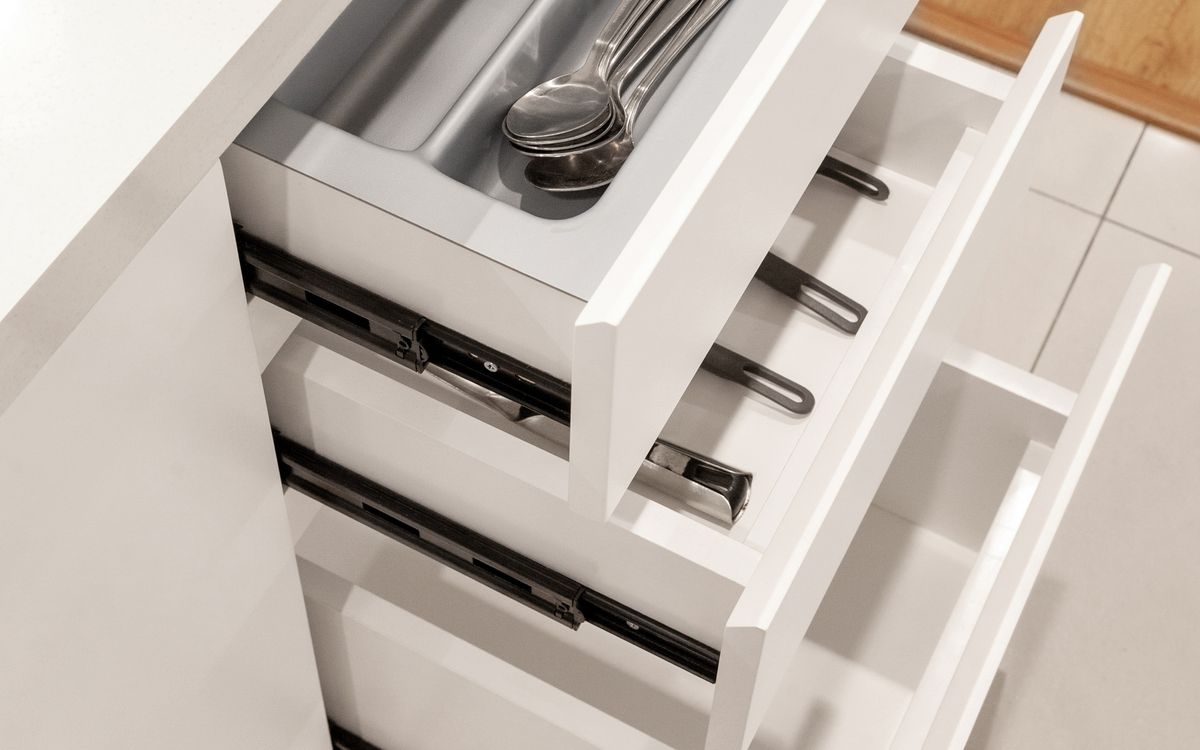
A hand-pulled drawer is not a lid mechanism at all. There is no lid; the bin is inside a cabinet and the cabinet door is the door. It wins on hiding the waste completely and on floor space, and it loses on effort: every use is a pull and a push, and the drawer needs clear floor in front of it when it is out.
The three stations, and what each one is for
simplehuman 58L Step Recycler (CW2219)
The pedal option, and the one with the longest warranty in this group. Capacity is 58 litres split 34 litres for trash and 24 litres for recycling, in a body measuring 22 inches wide, 14.2 inches deep and 25.8 inches tall, weighing 21.3 pounds empty.
The split is deliberately unequal, and it is the right way round for most households: the trash side takes the larger share because food waste is dense and the recycling side compacts. The recycling side has a handled inner bucket that lifts out as a unit, which is what you want at the kerb. The trash side has no inner bucket at all in this generation — the liner goes straight into the shell against the liner rim, which is how simplehuman frees up the volume it claims.
Bag retention is the strongest of the three. The stainless liner rim lifts, the bag goes in, and the rim closes over it to grip the liner and hide the skirt. A liner pocket inside the can holds a 20-pack and dispenses one at a time. Both features exist to solve the same problem — a bag that slides down — and together they are the reason this design is copied so widely.
The mechanism is a spring-loaded steel pedal that simplehuman rates at 150,000 steps, with a damper it calls Lid Shox to slow the close. In a kitchen with an island and a free wall, this is the station that needs the least thought.
simplehuman 58L Dual Compartment Sensor Can (ST2050)
Same capacity and the same 34/24 split, in a slightly different body: 22.3 inches wide, 13.1 inches deep and 25.1 inches tall. That is 1.1 inches less depth than the pedal version, which matters if the can has to sit in a narrow slot beside a counter.
The lid opens on a hand wave or on the spoken words “open can”, stays open on “stay open”, and closes itself after ten minutes if nobody tells it otherwise. The motor is quoted at 52 decibels, which is quieter than a normal conversation and about the level of a refrigerator hum.
It runs from the included plug-in adapter or from six AA alkaline batteries, and simplehuman lists it as ADA compliant — a real distinction for anyone who cannot operate a pedal, and the only one of these three that can be used without a foot or a free hand.
The trade is warranty and complexity. Five years rather than ten, a lid that will open when a passing arm crosses the sensor, and a power lead to route if you use the adapter. The liner rim and liner pocket carry over unchanged, so bag retention is identical to the pedal model.
Rev-A-Shelf 53WC Series Double 35 Qt Pull-Out Waste Container (53WC-1835SCDM-217)
The cabinet option, and the only one here that removes the bin from the room entirely. The unit measures 14.375 inches wide, 22.09 inches deep and 19 inches high, carries two 35-quart bins — 8.75 gallons each, about 33 litres — and runs on under-mount soft-close slides rated at 90 pounds.
Rev-A-Shelf publishes a minimum cabinet opening of 14.5 inches wide by 22.125 inches deep by 20.25 inches high, identical for face-frame and frameless cabinets. That opening is a 15-inch base cabinet with the drawer above removed or the opening cut down, and the depth figure is why this unit only fits a full-depth 24-inch base cabinet, not the shallower box under a sink.
Two details catch people. The first is that the bins are in line, front to back, not side by side, so the rear bin is only accessible when the slides are at full extension — which they are, and which is the reason to pay for full extension rather than three-quarter. The second is that the door-mount brackets are included and required: the cabinet door comes off its hinges, attaches to the pull-out frame, and then swings and slides as one piece. A drawer front above the door will not work.
Bag retention is the weak point. The bins are open plastic tubs with a rim, and the bag is draped over that rim and tucked under, with nothing gripping it. Under the weight of a full load the liner creeps down, and there is no rim, ring or clip to stop it. Optional lids are sold separately, which means odour control is a separate purchase rather than part of the design.
Cabinet interior width: the measurement that fails most installs
The pull-out fails here more often than anywhere else, because the number that matters is not the cabinet’s nominal width. A “15-inch cabinet” is 15 inches of face frame, and the opening behind it is narrower: 14.5 inches on the Rev-A-Shelf specification, which leaves half an inch of total clearance around a 14.375-inch unit. That is the whole tolerance.
Measure the opening, not the cabinet, and measure it at the top, middle and bottom. Cabinet boxes are rarely square, and a 1/8-inch taper is normal in older kitchens. Take the smallest reading.
Then check height. The unit is 19 inches tall and the published opening is 20.25 inches, so there has to be 20.25 inches of clear height inside the cabinet, which usually means a full-height door cabinet with no drawer above it. If there is a drawer, the pull-out does not go in without removing it.
For the floor-standing cans the equivalent number is different: 22 to 22.3 inches of width and 13 to 14.2 inches of depth, plus enough clearance behind for the lid. Both simplehuman models use an internal hinge, so they can sit against a wall without the lid striking it, which is worth knowing if the only free slot is at the end of a run.
Bag retention: rim, pocket or nothing
This is the specification nobody lists and everybody notices within a week.
The two simplehuman stations use a liner rim that lifts and closes over the bag, plus a pocket that holds a 20-pack of the correct liner. The result is that the bag cannot slip, the skirt cannot show, and the liner is always the right size because the pocket only holds one code — Code H for both 58-litre models.
The Rev-A-Shelf bins have no retainer. The bag goes over the rim and stays there by friction and by being roughly the right size. A 35-quart bin takes a standard 8- to 9-gallon kitchen bag, which is the most common size sold, so the fit is not difficult — but a heavy load will pull the bag down, and there is nothing to grip it.
The practical consequence is a different bag strategy per station. Custom-fit liners for the rim cans, because that is what the rim is designed around. Standard 8- to 9-gallon drawstring bags for the pull-out, bought by the box, with the drawstring doing the work the rim cannot.
Capacity per person, and why the 34-litre side matters
Simplehuman publishes a capacity guide alongside these cans: 30 litres for a one- to two-person household, 45 litres for two to three, 55 litres for three to five, and 58 litres in the 24/34 split for three to five. Those figures are for total household waste, not per stream, and they assume the bin is emptied about weekly.
That makes the 58-litre stations the right size for a household of three to five, and oversized for one or two — a single person filling a 34-litre trash compartment is changing a nearly empty bag, which is the most common complaint in owner reviews of large dual bins.
The pull-out has more total capacity and less usable capacity at once. Two 35-quart bins are 70 quarts, or about 66 litres, which is more than either floor can. But each bin is a separate lift-out, and the rear one requires the drawer at full extension. In practice a 15-inch cabinet station holds one bag of trash and one bag of recycling, changed roughly as often as a 58-litre floor can, with more effort per change.
If the household produces more than two streams, none of these three does it in one unit. The third stream is a separate purchase in every case: simplehuman sells a 4-litre compost caddy that docks magnetically to the side of either 58-litre can, and the Rev-A-Shelf route is a second pull-out in the next cabinet.
Height, lid travel and what sits above the can
The two floor cans are 25.1 and 25.8 inches tall, and both need vertical room for the lid, which lifts from the rear. That is fine in the open, and a problem under a counter overhang, a wall cabinet that comes down low, or a window sill.
The pull-out has no lid travel, which is one of its quieter advantages: it can sit under a counter with 20.25 inches of cabinet height and nothing above it has to move.
Also check what the can stands on. The floor cans need a level floor and about an inch of clearance behind for the lid’s internal hinge, and the pull-out needs a flat cabinet floor — which is why sink cabinets, with a raised floor around the plumbing, are a poor host even when the opening measures correctly.
The shortlist
For a kitchen with a free wall and no interest in batteries, the simplehuman 58L Step Recycler (CW2219) is the station to buy: a 150,000-step pedal, a ten-year warranty, and the liner rim and pocket that make bag changes a five-second job.
For a household where someone cannot use a pedal, or where the can sits where a foot cannot reach it, the simplehuman 58L Dual Compartment Sensor Can (ST2050) does the same job hands-free at 52 decibels, with the shorter warranty and the power lead as the price.
For a kitchen with a spare 15-inch base cabinet and no floor space at all, the Rev-A-Shelf 53WC Series Double 35 Qt Pull-Out Waste Container (53WC-1835SCDM-217) hides the whole problem behind a door, provided the opening measures 14.5 by 22.125 by 20.25 inches and you accept a bag with no retainer.
Whichever you choose, take the width measurement before anything else, then check the liner code. Those two numbers decide whether the station works; the lid is a preference. If the clutter around the bin is the wider problem, clearing the counter covers the systems that compete for the same floor. For what the bins hold once they are full, storage capacity math converts quarts into something you can plan with.