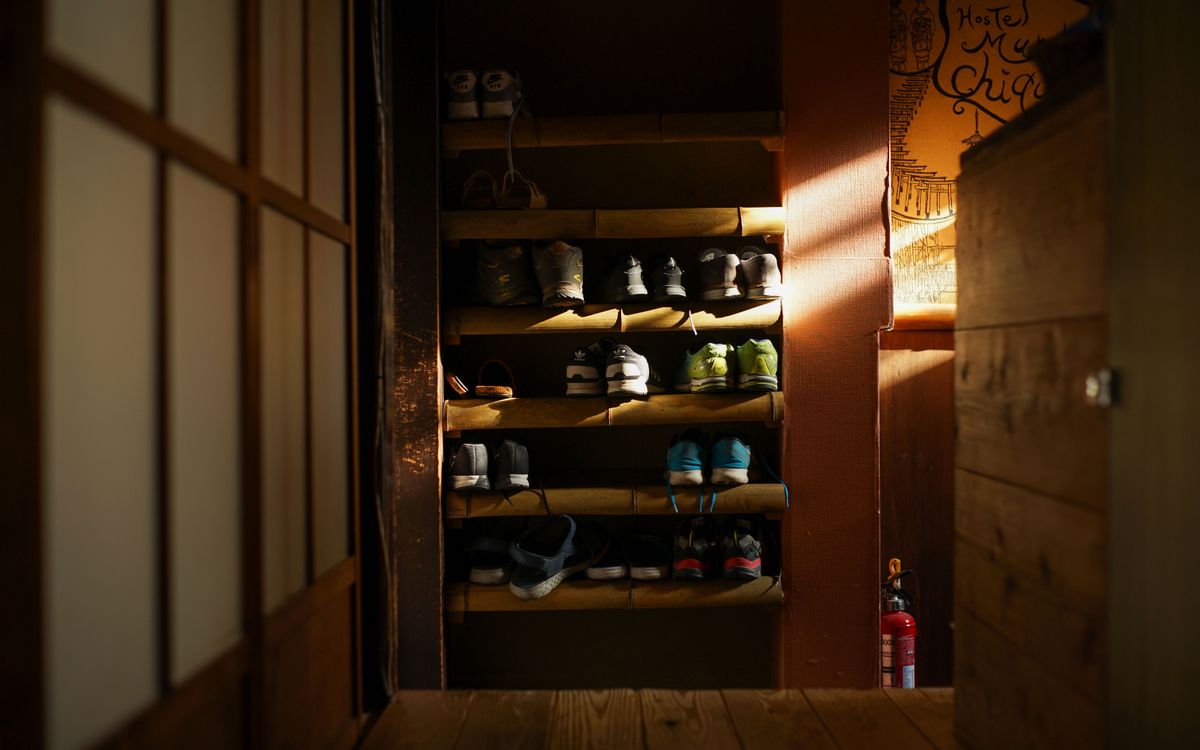
Shoe racks are sold by tier count, because tier count is the only number that fits in a product title. It is also the least useful number on the box. A ten-tier rack with 6.7 inches between tiers holds forty pairs of flats and about six pairs of boots, and both of those figures come from the same published dimensions.
The three racks below are all sold for entryways and hallways, and all three publish enough detail to work out what they hold before you buy. What separates them is not the number of tiers. It is the clear height between them, the depth of each shelf, and whether the rack is wide enough to put a second pair beside the first.
What a tier count is actually measuring
A tier is a horizontal surface. Capacity is the product of three things: how many pairs fit across the surface, how many surfaces you have, and how many of those surfaces are tall enough for the shoes in the house.
Only the middle term appears in the product name. The other two are buried in the specification table, and one of them — clear height — is usually not stated at all. On a rack with a fixed frame, clear height is the total height divided by the number of tiers, minus the thickness of each shelf. On a rack with adjustable shelves, it is whatever you set, which is the feature worth paying for if anyone in the house wears boots.
The width term is the one buyers underestimate. Shoes are stored in pairs, side by side, so each pair needs roughly twice the width of one shoe: 8 to 9 inches for a men’s size 10, 7 to 8 for a women’s size 8. That is why a 26.5-inch rack holds three pairs per shelf and a 36.2-inch rack holds four, and why the difference between those two racks is eight pairs over three tiers — more than the difference between three tiers and four tiers on the narrow rack.
Three racks, measured the same way
All three are current products with published dimensions. Two are three-tier racks in metal and one is a ten-tier tower, and the tower is included because it shows what a high tier count does and does not buy.
SONGMICS Shoe Rack 3-Tier Shoe Organizer (ULSA303W03)
The wide, low option. It measures 11.8 inches deep, 36.2 inches wide and 21.7 inches high, weighs 2.9 pounds, and is built from metal tubes with plastic connectors. Each tier carries a published 22 pounds, and the whole rack is rated to 66.
SONGMICS claims 16 pairs of men’s shoes or 20 pairs of women’s, and the claim depends on a trick: the frame can be used upside down, which puts the shelves at a different height and opens up space under the bottom one. Used upright, three tiers give three surfaces. Used upside down, the same frame gives you a low gap at the floor plus three shelves, which is where the fourth row of pairs comes from.
At 36.2 inches wide and four pairs per tier, twelve pairs is the honest upright figure for adult shoes. The other four to eight pairs in the claim come from that flipped configuration and from smaller sizes.
Seville Classics 3-Tier Resin Slatted Shoe Rack
The one with published clearances. Overall it is 26.5 inches wide, 12.25 inches deep and 18.5 inches high, and the shelves themselves are 25.5 by 11.6 inches. Seville publishes 5.5 inches of space between tiers and 3.25 inches under the bottom shelf, with five resin slats per shelf carrying up to 30 pounds each and 90 pounds for the unit.
Those clearances are the whole story. Five and a half inches fits a sneaker — a men’s size 10 sneaker stands about 4.5 to 5 inches at the heel collar — with half an inch to spare. It does not fit an ankle boot at 6 inches or a tall boot at 13. The only tier that takes a boot is the top, where there is nothing above it.
Three pairs across 25.5 inches is 8.5 inches per pair, which is comfortable for women’s shoes and tight for men’s. The rack is also designed to interlock sideways and stack up to three high, which is how it reaches a useful capacity: one unit is nine pairs at best, three stacked are 27.
SONGMICS 10-Tier Shoe Shelf (ULSR210B02)
The tall option, and the clearest example of the tier-count problem. Eleven inches deep, 32.7 inches wide, 62.6 inches high, with 6.7 inches of clear height between tiers — a published figure, which is rare at this price. Each tier is rated to 11 pounds, the shelves are non-woven fabric on metal tubes, and the whole unit weighs 6.8 pounds.
The listing claims up to 40 pairs. Four pairs across 32.7 inches is 8.2 inches per pair, so the claim works for women’s shoes and flats and starts to fail at men’s size 10, where three pairs across is the realistic figure and 30 pairs is the ceiling.
The rack splits into two five-tier units, which is genuinely useful: a five-tier tower beside the door and a second one in a bedroom closet. It also ships with two anti-tip kits, which a 62.6-inch unit that weighs 6.8 pounds needs.
Pairs per shelf, worked out
The arithmetic is simple enough to do in the shop, and it is the only way to compare racks of different widths.
| Model | Width | Pairs per tier | Tiers | Pairs, upright |
|---|---|---|---|---|
| SONGMICS ULSA303W03 | 36.2 in | 4 at 9.05 in per pair | 3 | 12 |
| Seville Classics 3-Tier | 25.5 in shelf | 3 at 8.5 in per pair | 3 | 9 |
| SONGMICS ULSR210B02 | 32.7 in | 4 at 8.18 in per pair, 3 at 10.9 in | 10 | 40 at best, 30 for men’s |
Take the shelf width, divide by the width of a pair, and round down. That is the number per tier. Then multiply by the tiers you can actually use, which is where the next two sections come in.
What this shows is that width beats tier count at the low end. The 36.2-inch three-tier rack holds twelve pairs; the 26.5-inch three-tier rack holds nine. To match the wide rack with the narrow one you need to stack a second unit, which takes the height from 18.5 inches to 37 inches and needs the floor space of two racks.
Tier height, and where boots break the count
A shoe rack fails at the top and bottom of the shoe, not the middle. Flats, sandals and low sneakers are 3 to 4 inches tall. Sneakers are 4.5 to 5. Ankle boots are 5.5 to 7. Tall boots are 13 to 15 inches of shaft, and that is the number that decides the layout.
At 6.7 inches of clearance, the SONGMICS tower takes everything except ankle boots and up. At 5.5 inches, the Seville rack takes sneakers and nothing taller. The consequence is the same for both: a boot pair has to go on the top tier, or a shelf has to come out.
Removing one shelf on the tower combines two 6.7-inch gaps into one of about 13.5 inches, which takes most tall boots. The cost is not one shelf’s worth of capacity; it is two tiers’ worth, because the boot pair occupies the space two shelves would have covered and adds only one pair to the count. Ten tiers become eight usable surfaces, and a household with three pairs of tall boots loses six tiers of nominal capacity to store three pairs.
That is why the real capacity question is not “how many tiers” but “how many tiers are 13 inches or more”. A rack with four fixed tiers at 13 inches holds four pairs of boots and eight pairs of shoes. A rack with ten tiers at 6.7 inches holds forty pairs of flats and no boots at all.
Depth: why a tier is one row
Every rack here is 11 to 12.25 inches deep, and that number decides whether a tier can hold two rows of shoes or one.
A men’s size 10 shoe is about 11.2 inches long. Placed heel-to-toe, two shoes need 22 inches of depth, which no hallway rack has. Placed side by side, the pair needs 8 to 9 inches of width and 11.2 inches of depth, which is exactly what these racks provide — with 0.2 inch to spare on the 11.8-inch SONGMICS, and slightly over on the 11-inch tower, where a size 10 heel hangs a little past the front edge.
The consequence is that every tier is a single row, and capacity comes only from width and tier count. It also means the depth is not wasted: 11 inches is what a shoe needs, and a rack that is 14 inches deep would not hold a second row, only deeper shoes.
The one place depth matters beyond fit is the walkway. A rack 11.8 inches deep plus a 2-inch gap at the wall takes 14 inches out of a hallway. In a 42-inch hall that leaves 28 inches of clear path, which is passable but tight for two people; in a 36-inch hall there is no arrangement that works, and the rack belongs in a closet instead.
Load ratings and the top tier
The published loads are 22 pounds per tier on the SONGMICS three-tier, 30 pounds per shelf on the Seville, and 11 pounds per tier on the ten-tier tower. Those numbers look generous until they are divided by the shoes.
A pair of men’s leather boots is 3 to 4 pounds. Four pairs on an 11-pound tier is 12 to 16 pounds, which exceeds the rating before the tier is full. The same four pairs on the Seville’s 30-pound shelf is not close to a problem. This is the reason heavy footwear belongs on the bottom tier of a tall rack and on any tier of a low one: the rating is per tier, and the tiers are identical.
The tower’s 11-pound rating is also a warning about the frame. Non-woven fabric shelves on 0.5-inch metal tubes are light by design — the whole unit is 6.8 pounds — and a 62.6-inch tower at that weight tips rather than collapses. The two anti-tip kits in the box are not optional extras; they are the reason the thing can stand next to a door with a bag swinging past it.
Nothing in this comparison publishes a total load that exceeds 90 pounds, and none of them needs to. The floor carries the rack; the rating is about what a shelf can hold without the fabric or the slats sagging.
Width, walkway and the hallway
The last number is the one that decides whether the rack can live where the shoes are.
Measure the hallway’s clear width, subtract the rack’s depth plus a 1-to-2-inch gap at the wall, and see what is left. A 36.2-inch-wide rack in a 48-inch hallway leaves 34 inches of walkway and 6 inches of wall on each side — comfortable. The same rack in a 42-inch hallway leaves 28 inches, which is one person carrying a bag and not two people passing.
Length matters too, and it is the number people forget. A 36.2-inch rack needs 36.2 inches of uninterrupted wall, and a hallway with a door casing at each end often has 34. That is the case for the 26.5-inch Seville unit: it fits between casings that the wide rack cannot, and it interlocks sideways, so two of them give 53 inches of racking in two pieces that can turn a corner.
The shortlist
For a hallway with 36 inches of free wall and adult shoes to store, the SONGMICS Shoe Rack 3-Tier Shoe Organizer (ULSA303W03) holds the most per inch: four pairs per tier across 36.2 inches, twelve pairs upright, and a light enough frame to move when the hall gets painted.
For boots, or for a wall that cannot take 36 inches, the Seville Classics 3-Tier Resin Slatted Shoe Rack is the better buy. The 5.5-inch clearance is honest about what it holds, the 30-pound shelves take real footwear, and the interlock design lets two units fit a space one wide rack would fill badly.
For a narrow strip of wall and a household of flats and sneakers, the SONGMICS 10-Tier Shoe Shelf (ULSR210B02) gives the most surfaces in the smallest footprint — as long as you accept that the 40-pair figure assumes four pairs per tier and that a single pair of tall boots costs two tiers.
Whichever you choose, take two measurements before ordering: the clear height of the gap you intend to use for boots, and the width of the wall between door casings. If the shoes are outgrowing the rack, the depth rule behind every shelf explains why an 11-inch rack is the right depth and not a compromise, console table storage covers the surface that usually ends up holding the keys instead, and converting an entryway closet is the alternative when the hallway has no wall left.