An entryway closet is usually built as a coat closet: one rod at 66 inches, one shelf above it, and 24 inches of depth that nobody measures until the boots arrive. Converting it is not a carpentry project so much as a stacking problem. The same volume has to hold hanging coats, a place to drop keys and mail, and somewhere to sit while you put shoes on, and each of those wants a different height band.
The good news is that the numbers are already fixed by the building. A reach-in closet is 24 inches deep, a door opening is 24 to 36 inches wide, and the rod height that lets a coat hang clear of the floor is 66 inches. Everything below that is a decision about how to divide the remaining 66 inches into three zones.
Start with the three measurements that cannot change
Before anything comes out of the closet, take three readings.
The first is interior depth, from the back wall to the inside face of the door or the door frame. Twenty-four inches is standard. If it reads 22 or less, the closet is a shallow reach-in and the hanging zone has to be reconsidered, because a rod needs 12 inches from the back wall and a hanger needs about 17 inches of swing to come off the rod.
The second is the door opening and its swing. A 30-inch door that swings into the room gives you the full closet width to work with. A 30-inch door that swings into the closet takes a 30-inch arc out of the floor you were planning to use, and a bifold takes two 15-inch panels that fold back against the jambs. Measure the opening, then watch the door open and note where it stops.
The third is the header height — the underside of the opening, not the ceiling inside. A closet with a 96-inch ceiling often has an 80-inch header, and anything above 80 inches inside the closet can only be reached through the opening, which means a shelf at 84 inches is a shelf you will use once.
Write all three down. Most of the layout conflicts in this article come from one of them being 2 inches off what the plan assumed.
The three zones, and the height each one gets
The conversion works because the three uses stack in the order you use them: you hang the coat at shoulder height, you drop keys and mail at hand height, and you sit at knee height. Read from the floor up, the closet divides like this.
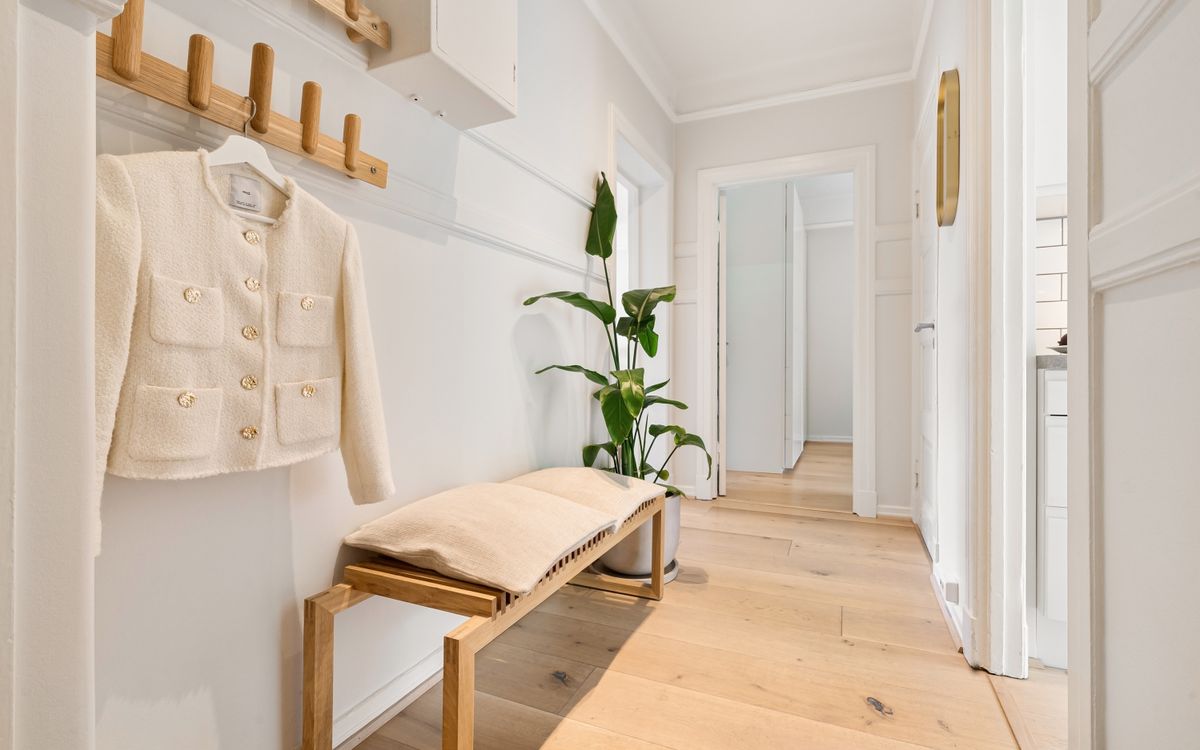
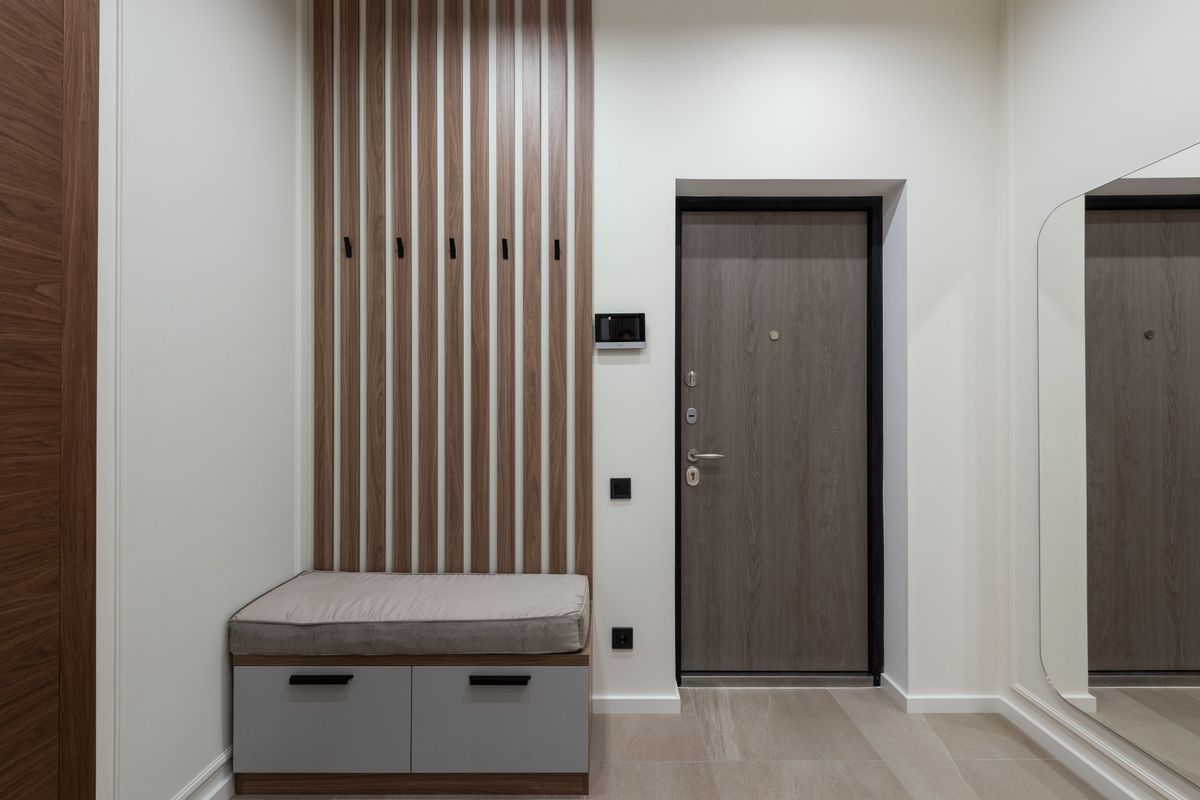
Sit, 0 to 20 inches. A bench seat at 17 to 19 inches, with open space underneath for the shoes that are in rotation. This is the zone that a coat closet wastes entirely, and it is the one that changes how the entryway works, because it gives you somewhere to sit that is not the floor.
Drop, 20 to 48 inches. The band between the top of the bench and the bottom of the coats. On a 24-inch-deep closet this is where a shallow shelf, a row of hooks or a small drawer unit goes, and it is the only zone at a height you can use with one hand while holding a bag.
Hang, 48 to 80 inches. The rod. Sixty-six inches is the standard height for a single rod, because it clears a long coat and keeps hangers within reach of most adults. The shelf above it sits at least 2 inches above the top of the rod, and 68 to 70 inches is the usual figure.
The zone that causes trouble is drop. On paper it looks like a big empty band, but a coat hanging on the rod occupies the space in front of the wall from 48 inches up, and a coat is 4 to 6 inches thick on the hanger. Anything mounted on the back wall between 48 and 66 inches will be behind the coats and effectively lost. That is why the drop zone belongs below 48 inches, on the side wall, or on the door.
Shelf heights, by what goes on them
A shelf height is not a preference; it is the height of the tallest thing that has to stand on it plus the room to get your hand over the top.
For shoes on a shelf, 7 inches between shelves takes flats, sneakers and low boots. Thirteen to 15 inches takes ankle and tall boots standing upright, which is why a boot shelf is usually a single tall gap rather than a stack of thin ones. If the household has both, the efficient arrangement is two 7-inch shelves and one 14-inch gap, not four 7-inch shelves.
For folded goods, 12 inches between shelves is the working number. A stack of four sweaters is about 10 inches tall, and the extra 2 inches is what lets you slide the top one out without pulling the stack apart.
Shelf depth is the other half of the decision, and it is where a 24-inch closet gets awkward. A shelf that is 12 inches deep leaves 12 inches in front of it, which is the same 12 inches the coats need. At the height where coats hang, a 12-inch shelf is fine because it sits above the rod. Below 48 inches, a 12-inch shelf eats half the closet floor and leaves 12 inches for a bench seat, which is shallow for sitting but workable at 15 inches if the shelf above is set high.
The alternative is a side-wall stack: shelves on the 24-inch-deep end wall, 12 inches deep, running from the bench up to the rod. That gives four shelves of 12 by 24 inches without taking any width from the hanging zone, and it is the arrangement that fits best in a closet 36 inches wide or less.
The bench, and what fits underneath
A bench seat at 17 to 19 inches is the same height as a dining chair, and that is the point: you sit on it the way you sit on a chair, leaning forward to reach your feet. Above 20 inches most adults perch instead of sitting, and the bench stops doing its job.
The space underneath is where the shoe capacity comes from, and it is decided by the seat height minus the thickness of the seat. A 17-inch seat built from a 1.5-inch top leaves 15.5 inches of opening, which takes a tall boot standing upright. A 19-inch seat with a 2-inch top leaves 17 inches. Either works; what does not work is a bench with a shelf or a drawer under the seat, because that converts the opening into 7 inches of shelf and limits you to low shoes.
Depth matters as much as height. A bench 15 inches deep takes a pair of size 10 shoes side by side with room in front, and leaves 9 inches of the 24-inch closet depth for the coats behind it — which is not enough, since the coats need 12. The bench has to be shallower than the hanging depth or the two zones fight. Twelve inches of bench depth is the number that works in a 24-inch closet: it takes a pair of shoes with the heels against the back, and it leaves 12 inches for the coats.
If the closet is 28 inches deep or more, a 15-inch bench is the better choice, and the extra 3 inches goes to the hanging zone rather than to the bench.
Under-bench storage also needs a floor that can take the load. Shoes are dense — a pair of boots is 2 to 4 pounds, a family’s rotation is 30 to 50 pounds — but the bench legs carry that, not the shelf. What the bench seat itself carries is a person, briefly, which is why a bench spanning more than 36 inches needs a center leg or a cleat into a stud at the back.
Behind-the-door hooks, and the swing they need
Hooks on the inside of the closet door are the cheapest storage in the room and the most likely to make the closet unusable, because a coat on a hook is 4 to 6 inches deep and the door has to swing past the rod.
The test is a simple one. Open the door fully and look at the gap between the door face and the nearest fixed thing — the rod, the shelf edge, the bench. If the door swings into the closet and that gap is less than 6 inches, a hook with a coat on it will stop the door before it is open, and the coat will be crushed against the shelf.
Hooks on a door that swings out into the room are a different case entirely. The door face is then clear, and hooks work at any height that suits the household: 60 to 66 inches for adults, 48 inches for children, and no higher than 48 inches if someone in the house reaches from a seated position.
Hook projection is the number to check, not hook length. A hook that projects 2.5 inches from the door holds a coat on a hanger loop; a hook that projects 3.5 inches holds a backpack by its strap. Anything deeper than 4 inches will foul the frame when the door closes, and a door is typically 1.375 to 1.75 inches thick, so a hook screwed to the face has that thickness plus the frame reveal to work with.
Load is the other consideration. A screw-in hook into the door’s solid stile takes a coat without trouble; a hook into a hollow-core door’s skin takes the coat and then the skin. If the door is hollow, use an over-the-door bracket that spreads the load across the top edge rather than drilling the face.
When the closet is 22 inches deep
Plenty of entryway closets are 22 inches deep, and the standard 12-inch rod offset leaves 10 inches in front of the coats, which is not enough for a hanger to swing off the rod without scraping.
Three fixes work, in order of how much they cost.
Move the rod closer to the back wall. A rod at 10 inches instead of 12 gives 12 inches in front and puts the shoulders of the coats almost against the wall. It works for shirts and light jackets and fails for puffer coats, which need the full 12 inches or they hang crooked and lose their shape at the shoulder.
Switch to angled hangers. A slim, angled hanger presents the garment at 45 degrees and needs about 14 inches of depth instead of 17. That recovers 3 inches without moving anything, and it is the only fix that does not require tools.
Give up the hanging zone for part of the width. A 36-inch closet split into 24 inches of hanging and 12 inches of shelves gives you a full-depth rod plus a place for shoes, at the cost of eight or nine hangers. In an entryway that holds four coats and a dog lead, that trade is usually the right one.
What does not work is forcing a 22-inch closet into a 24-inch layout. The coats will hang at an angle, the door will not close over them, and the bench will be 10 inches deep, which is not enough for a pair of shoes.
The build order that avoids rework
Take the old shelf and rod out first, then patch and paint, because everything after this point is measured from bare walls.
Then mark the three zone lines on the side walls with a pencil and a level: 17 to 19 inches for the bench seat, 48 inches for the top of the drop zone, 66 inches for the rod and 68 to 70 for the shelf above it. Check the marks against the door swing with the door half open.
Then install in this order: bench, drop-zone shelf or hooks, rod and its shelf. The bench goes first because it is the item most likely to force a change — a bench that arrives 2 inches deeper than planned changes where the rod can sit.
Finally, check the rod’s span. A wood rod is usually good for 3 to 4 feet between supports and a steel rod for 4 to 6, and a rod that spans the full closet width without a center bracket will sag under a winter’s coats. If the closet is wider than 48 inches, plan a center support or a shelf-and-rod bracket at the midpoint.
Once the zones are in, the thing that decides whether the closet stays usable is what sits in the drop zone. The minimum key and mail layout covers how much surface that actually needs. If the shoes are going to outgrow the space under the bench, shoe rack capacity explains what a rack’s tier count really holds, and console table storage is the alternative when the closet turns out to be too shallow to convert.