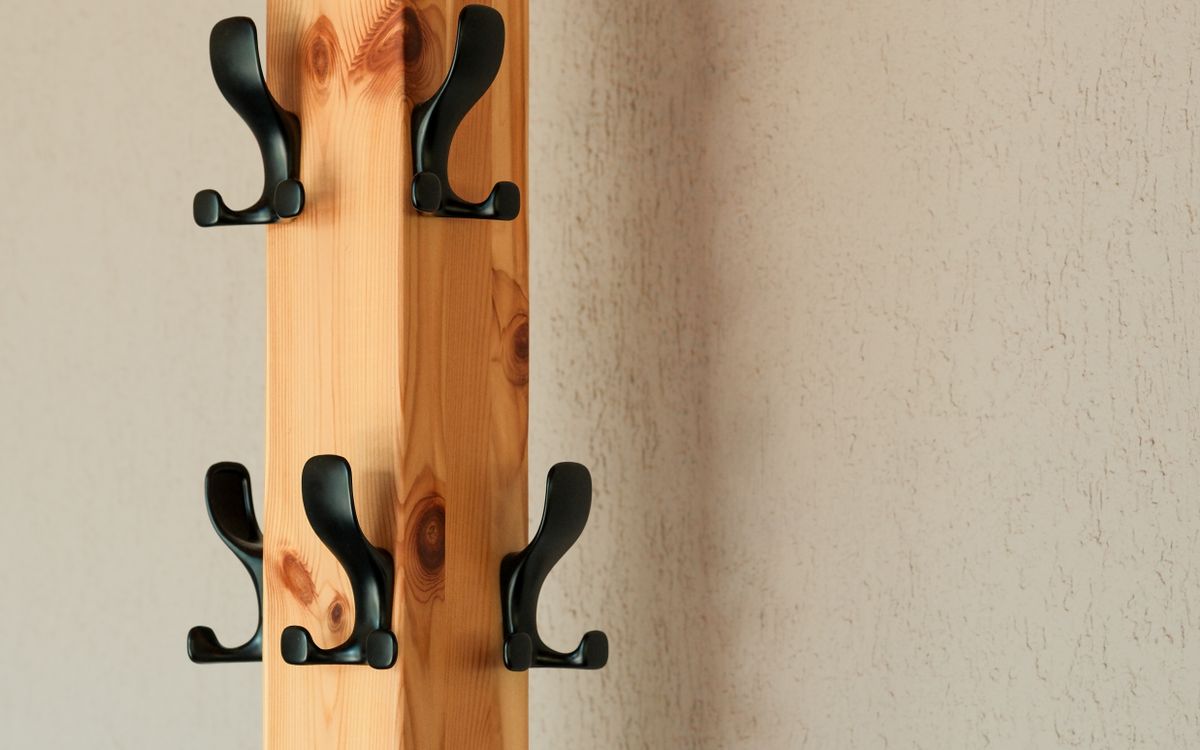
A coat hook is the cheapest storage product in the house and the one most likely to be installed wrong, for a simple reason: the number on the package describes the wall, and the buyer is thinking about the coat.
Read the specification line closely and you find one figure covering two very different installations. Liberty lists its 3-1/2 inch heavy duty coat and hat hook at 35 lb when mounted into solid wood studs or when wall anchors are used. National Hardware’s single-prong robe hook carries the same 35 lb. The consistency across brands is not a coincidence: 35 lb is roughly what a well-set hollow-wall anchor holds in half-inch gypsum, so it is the figure that keeps the product honest wherever it lands.
The figure on the package is the anchor’s number
Thirty-five pounds is not a property of a piece of cast metal. It is the capacity of the weakest fixing the manufacturer expects the buyer to use, which is why the same hook is sold with a 35 lb claim and would hold several hundred pounds on a joist.
Adhesive hooks work the other way, and their numbers are lower and more literal. Command’s medium hook is listed at 3 lb, the large at 5 lb, and one large model in the range at 7 1/2 lb with two strips. Those figures do not change with the wall, because the strip is the fastener. What changes is how long the number holds: a strip that creeps under a steady load loses contact area slowly, and the drop happens months later on an ordinary day.
The practical consequence is that comparing a 35 lb screw hook with a 5 lb adhesive hook is not comparing quality. It is comparing a mechanical fixing to an adhesive one, and the two fail on different schedules.
What a winter coat actually weighs
Coat weight is not printed anywhere, but it is arithmetic if you know the cloth. Melton and heavy wool overcoating run 18 to 22 oz per square yard, and a man’s overcoat uses roughly 2 1/2 to 3 square yards of shell once the body, sleeves and facings are counted.
At 20 oz per square yard and 3 square yards, the shell alone is 60 oz, or 3.75 lb. A lining adds around 8 oz, interlining and canvas another 6 to 8 oz, and buttons, pocketing and a collar bring the total to about 4 1/2 lb. A mid-weight wool coat in the 14 to 16 oz range comes out nearer 3 lb. A down parka is lighter than it looks, commonly 2 to 3 lb, because the fill is mostly air. A leather jacket is the sleeper at 3 to 5 lb, since leather is heavier per square foot than wool.
So a house with four adults and four winter coats is hanging about 18 lb on the rail, and that is the steady load on a dry Tuesday. The dynamic load is what actually pulls hooks out: a person leaving in a hurry grabs a sleeve and pulls sideways, and that momentary load is several times the hanging weight. This is why a rail rated at 35 lb can fail under 18 lb of coats.
Children’s coats are the other end of the scale at 1 to 2 lb, which is why a low row of hooks for a five-year-old can be an adhesive product and still be the right answer. The load that breaks a child’s hook is usually a parent’s coat hung on it.
Gypsum board: what a toggle buys, and what it does not
Half-inch gypsum board has almost no pull-out strength of its own. A screw threads into paper and a chalky core, and a plastic expansion plug holds by crushing the core around itself, which is a friction joint that loosens a little every time the load moves.
A steel toggle changes the mechanism. It puts a bar on the back face of the board and clamps the board between that bar and the fixture, so the load is carried in bearing across a patch of gypsum rather than in friction along a hole. TOGGLER publishes 238 lb as the ultimate pull-out for its 3/16-inch SNAPTOGGLE in half-inch drywall, and applies the industry convention of taking a quarter of the ultimate figure as a working load, which puts the anchor at roughly 59 lb in service.
That is the number worth remembering for a coat wall: a toggle in half-inch drywall is a 50 to 60 lb fixing. It is plenty for a coat, and it is not unlimited. Two toggles on a rail double it, which is the reason a four-hook rail with two mounting points is a better product than one with a single keyhole.
There is one thing a toggle cannot fix. If the load hangs two or three inches off the wall, the anchor is carrying a bending moment as well as a weight, and the board around the hole is being pried rather than pulled. A hook with a long projection is therefore rated more conservatively than a flat bracket, for the same reason a shelf bracket is: the lever matters as much as the mass.
A stud, and the screw that is too short
Find a stud and the substrate stops being the variable. The hook’s 35 lb rating becomes irrelevant, because the framing behind it would take hundreds of pounds, and the limit moves to the hook body, the bracket, or the screw holding it.
The screw is where cheap installations fail, quietly. Hooks ship with short screws because they are designed to sit against drywall. Run one through half-inch gypsum board and the screw has about half an inch of engagement in the wood, which holds a coat and does not hold a coat plus a person leaning on it. For a hook in a stud, the screw should bury an inch and a half into the wood. Buy the screw for the wall, not the hook.
Studs are spaced 16 inches on center in most US framing, so a four-hook rail 24 inches long can catch two studs if it is placed well and one if it is placed badly. Mark the stud centers with a finder, then check with a thin nail, because a finder can be fooled by a pipe or a metal plate.
One hook against a rail of four
The single hook and the hook rail are different products with the same rating system, and this is where most coat walls go wrong.
A rail with four hooks and two screws has one mounting capacity, not four. Four winter coats at 4 1/2 lb each is 18 lb of steady load distributed across two screw positions, which is well within a pair of good toggles and well beyond a pair of plastic plugs. The rail’s packaging may say 35 lb, and that figure will be describing one hook’s fixing in the best case.
Spacing is the second half of the same problem. A wool overcoat is about 20 inches across the shoulders, and hanging on a hook it folds and hangs at an angle, so it occupies roughly 10 inches of rail. Four adult coats want 40 inches of rail, not 24, and a rail that is too short ends up with coats stacked on top of each other, which doubles the load on the middle hooks and makes the whole row useless. The arithmetic is the same one that governs hallway storage in a narrow run, where width is the scarce dimension and hooks win on projection.
Height is the third. A rail at 66 to 72 inches above the floor lets an adult hang a coat without lifting it above shoulder height, and a second rail at 48 inches serves children and bags. Two rails on one wall double the capacity without touching the fixing question, provided both are anchored properly.
Doors are a different substrate entirely
The over-door hook is sold as the renter’s answer, and it works, but not for the reason people assume. It does not fasten to anything. It hangs over the top edge of the door leaf and uses the door’s weight and the hinge side of the frame as its counterbalance.
An interior door leaf is 1 3/8 inches thick, with face skins of about 1/8 inch hardboard or plywood over a hollow core, and the top rail is the only solid timber in the assembly. A screw into the middle of a hollow-core door holds nothing at all, which is why every over-door hook clamps the top edge instead. The load then goes into the door, and from the door into the hinges and the jamb.
Two practical consequences follow. First, the capacity of an over-door hook is a door-and-hinge question, and no hook manufacturer can rate it for your door; the sensible limit is a couple of everyday coats rather than four winter ones. Second, the load hangs high on the leaf, well above the hinges, so it adds an overturning pull on the hinge screws as well as a sideways load on the jamb. A heavy coat works the door loose over a season and the latch starts catching. On a hollow-core door that is already loose, the hook accelerates a problem that was there before it.
If the door is the only wall available and the coats are heavy, the honest answer is a hook on the wall beside the door rather than on the door, even if it means a toggle and a tube of filler at the end of the tenancy.
Reading the package before you buy
Four questions cover almost every hook purchase, and none of them is about the hook.
What is the wall made of, and can it take a drilled fixing? If it is gypsum board on studs, plan on two toggles per rail and a screw long enough to reach timber where a stud is available. If it is plaster on lath, the plaster is the weak layer and a toggle that bears on the lath is a better bet than a plug that crushes it.
Is the rating per hook or per rail? If the packaging does not say, assume per hook and treat the rail’s two screws as the real limit.
How much will hang there in February, not in June? Four wool coats at 4 1/2 lb is 18 lb, and that is before anyone pulls one off in a hurry.
Does the hook stand off the wall? A long projection turns weight into leverage, and every inch of standoff makes the anchor work harder for the same coat.
The measurement that decides the installation is not the hook’s rating at all. It is the distance from the wall to the back of the coat, which is the number that tells you whether the hallway still has a walkway once four coats are hanging on it. For the same arithmetic applied to wet textiles in a bathroom, where the loads are lower but the moisture is constant, bathroom wall hooks sets out the tile and adhesive cases in full. And if the entryway has a bench in it rather than a coat wall, entryway benches with storage covers what the seat height and the lid do to the space you thought you had.