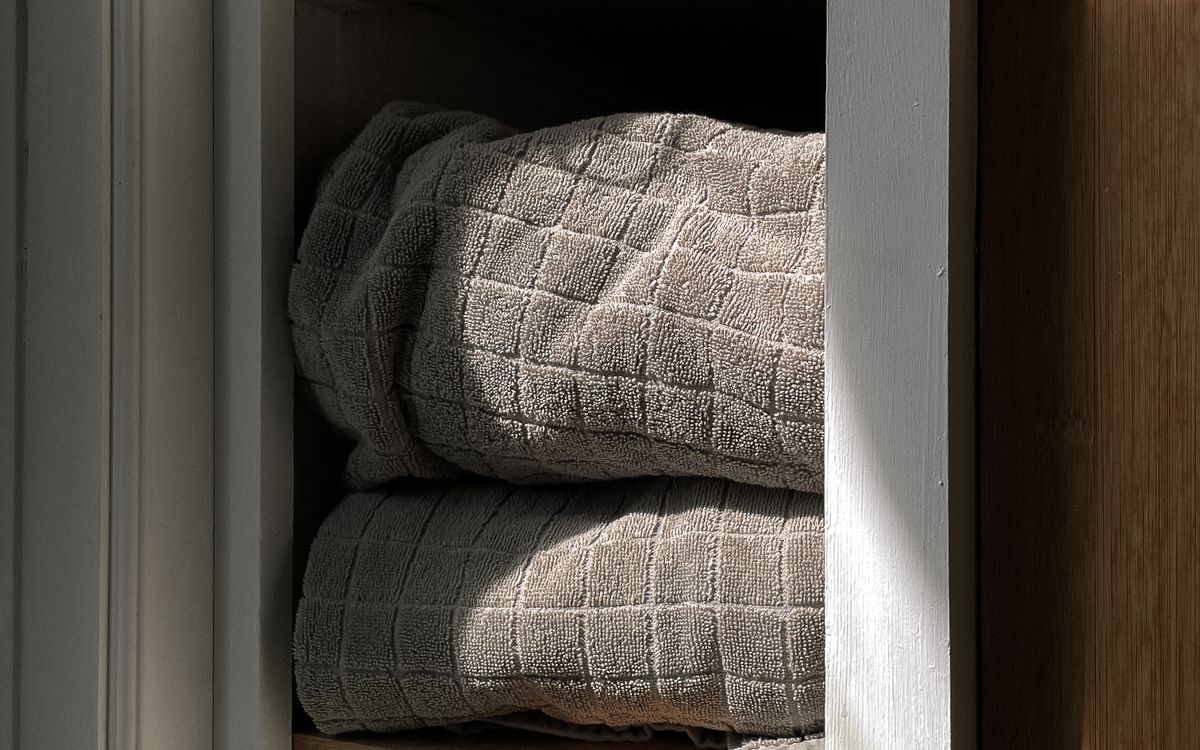
Most towel storage is built to hold towels, not to dry them. That is a reasonable thing for a shelf to do, and it is the reason so many bathrooms smell faintly of damp cotton: the towel goes from the bar to a folded stack while it is still carrying water, and the stack has no path for that water to leave.
Drying is a surface process. Water leaves a towel only where air touches it and carries vapour away, so any storage arrangement that puts towel face against towel face removes the surface the water needed. A stack is the worst shape for this. A single layer over a bar is the best. Everything else sits between the two, and the useful questions are how much exposed surface you are keeping, how far air has to travel to reach it, and whether the room gives that air anywhere to go.
Why a folded stack stays damp
Terry cloth holds water in the loops of the pile rather than in the weave, which is why a towel feels dry to the hand while still holding enough water to keep the fabric cool and heavy. That water has to evaporate, and evaporation depends on two things: the surface area exposed to air, and how quickly the air at that surface is replaced.
On a bar, a bath towel opened to its full 27-inch width has roughly 1,400 square inches of face exposed, front and back, plus both long edges. In a folded stack it has the top of the pile, the two short edges and whatever sliver of face is at the front. The faces that would have done most of the work are pressed against each other.
The air inside a stack is also still. Air that is not moving reaches vapour saturation close to the wet fabric and then stops accepting water; the towel can only dry as fast as vapour diffuses out through the gaps, which is slow. Add the fact that a folded towel is usually folded warm, straight off a body or out of a dryer that did not quite finish, and the middle of the stack can stay damp for days while the outer towels feel dry.
The path air has to take
A shelf that dries has a route through it, and the route is easiest to see from the side: air enters low at the front, rises through the space in front of the stacks, and leaves at the top of the closet or through the door gap.
That route needs three clearances, and all three are small enough to be lost by accident.
The first is the front gap. On a 14-inch shelf holding a 9-inch-deep stack, there is 5 inches of open shelf in front. Keep it open. A row of small bottles or a decorative basket placed at the front edge cuts the vertical channel and turns the shelf back into a closed box.
The second is the rear gap. A shelf that meets the back wall seals the bottom of the channel. An inch of clearance at the back, or a shelf that stops an inch short, lets air move up behind the stacks as well as in front of them.
The third is the gap above each stack. A stack loaded until it touches the shelf above closes the top of the channel at exactly the point where the moist air needs to leave.
Shelf spacing: twelve inches, and what is left of it
Twelve inches between shelves is the common figure for a linen closet, and it is calculated for storage rather than drying. A stack of four bath towels is about 9 inches tall, so a 12-inch gap with a three-quarter-inch board leaves a little over two inches of air.
Two inches is enough for a hand and not much else. For a shelf that is meant to dry towels rather than simply hold them, three things help: fewer towels per stack, a gap of at least three inches above the pile, and one shelf in the run with 16 inches of clearance so a damp towel can go there without being folded into a wedge.
The rule that matters is not to load to the shelf above. A towel touching the underside of the next shelf loses its top surface and gains a contact line where water wicks sideways into the board. The board does not dry as fast as the towel, so the damp edge persists.
If the closet is fixed at 12-inch spacing, the workable compromise is three towels per stack instead of four, and the spare towels stored flat in a lidded bin elsewhere. Capacity falls by a quarter; the number of towels that come out smelling of the previous tenant falls a great deal further.
Closed cabinet, open shelf, and the middle option
The choice between a closed cabinet and open shelving is usually made on looks, and it should be made on air changes.
A closed cabinet with a solid door and no gap is close to a sealed volume. Air inside it exchanges with the room only when the door opens, which for a guest-room linen closet might be twice a month. Dry towels do not care. Anything with residual moisture does, and the moisture has nowhere to go but into the other linens and the shelf board.
An open shelf is ventilated by definition, but in a bathroom it is ventilated with humid air. A shelf within about three feet of the shower is effectively inside the shower’s humidity plume, and towels there will pick up moisture from the room rather than lose it. Distance from the shower matters more than the shelf type.
The middle option is the one worth building if you have the choice: a closed cabinet with a louvred door, or a solid door with an inch of gap at the top and bottom. That gives you the visual tidiness of a cabinet with a slow but real stack effect — cool air in at the bottom, moist air out at the top. It is the same principle as a chimney, at a much smaller scale.
The bar, the hook, and the gap between towels
Drying happens before storage, and the first hour matters most because that is when the towel is carrying the most water.
A bar works because it holds the towel open. A 27-inch bath towel folded once over a bar and pulled straight has two layers, both exposed, with the entire width open to the room. A 24-inch bar will take two bath towels side by side with about two inches between them; closer than that and the towels touch, wick water into the contact line, and dry as one thick mass.
A hook works because it is convenient, and it is the wrong tool for a wet towel. The same towel on a hook is bunched into three or four folds with water trapped in the middle. It will feel dry on the outside within an hour and still be damp at the centre at bedtime. Hooks are right for robes, for a towel on its second day, and for the towel you are about to wash.
Double bars are the most common bad purchase in a bathroom. Two bars four inches apart with a towel on each put the back towel against the wall and the front towel against the back one, and neither gets air on both faces. If the wall has room for one bar and a hook, that is a better arrangement than two bars.
Humidity, season, and the twenty-four hour window
Room conditions set the ceiling on how fast anything dries, and they vary more than most people assume.
Published guidance on indoor air commonly puts the target relative humidity at 30 to 50 percent, with 60 percent as the level above which mould and mildew become likely on cool surfaces. A bathroom after a hot shower is at close to 100 percent for a while. Running the exhaust fan for about 20 minutes after a shower, or until the mirror clears, is the single cheapest way to shorten that window.
Winter helps and hurts. Indoor air is drier, so evaporation is faster, but exterior walls and window glass are cold, and a towel hung against them condenses on the wall side. Summer is the reverse: warm air holds more water, so the towel dries more slowly but the surfaces it touches are less likely to be below the dew point.
The practical clock is 24 hours. Public health guidance generally treats damp household textiles as something to dry within a day, and mildew can establish inside 48. A towel that has been in a stack for a day and smells sour has already told you the answer; washing it fixes the smell and leaves the storage arrangement unchanged.
A two-zone layout that works
The layout that solves this without a renovation is two zones in the same closet, one for drying and one for holding.
The drying zone is the open part: a bar on the back of the door, a rack over the bath, or the top shelf with 16 inches of clearance and nothing in front of it. Towels go there wet, spread out, one layer where possible.
The storage zone is the shelf run, and it only accepts towels that are dry. The test is simple: a towel that has been on a bar overnight and feels dry at the fold is ready; one that feels cool at the centre is not. Fold it loosely rather than tightly, set the stack back from the front edge to keep the air channel open, and leave three inches above the pile.
That is the whole system, and it costs no floor space. For the shelf dimensions that make the storage zone work, linen closet shelving depth covers the fold geometry, and if the damp problem is really an under-sink one, storing around a plumbing trap covers the cabinet that never dries out at all.