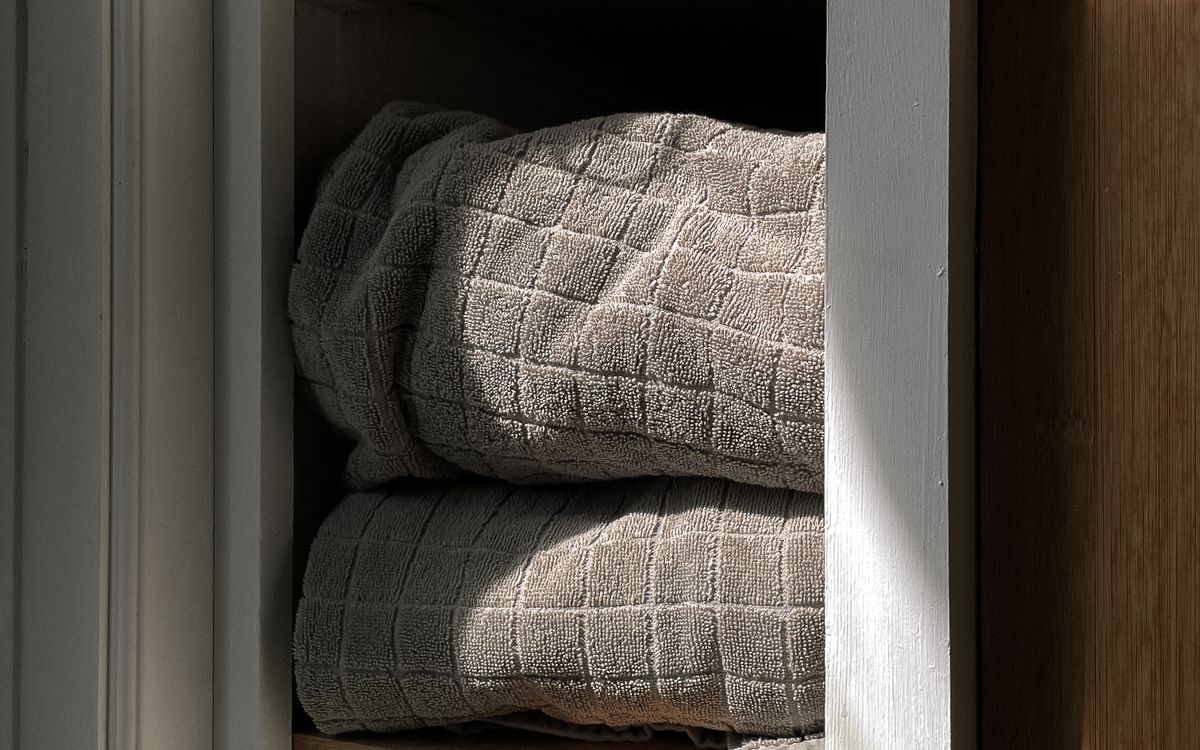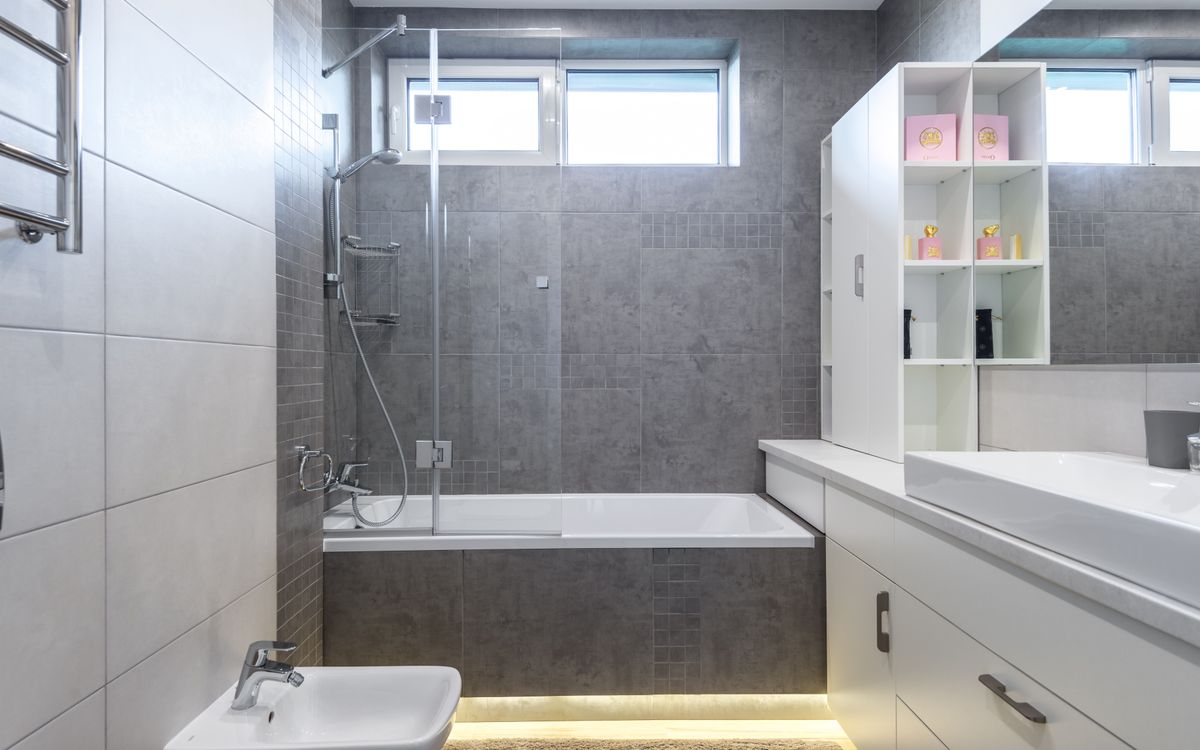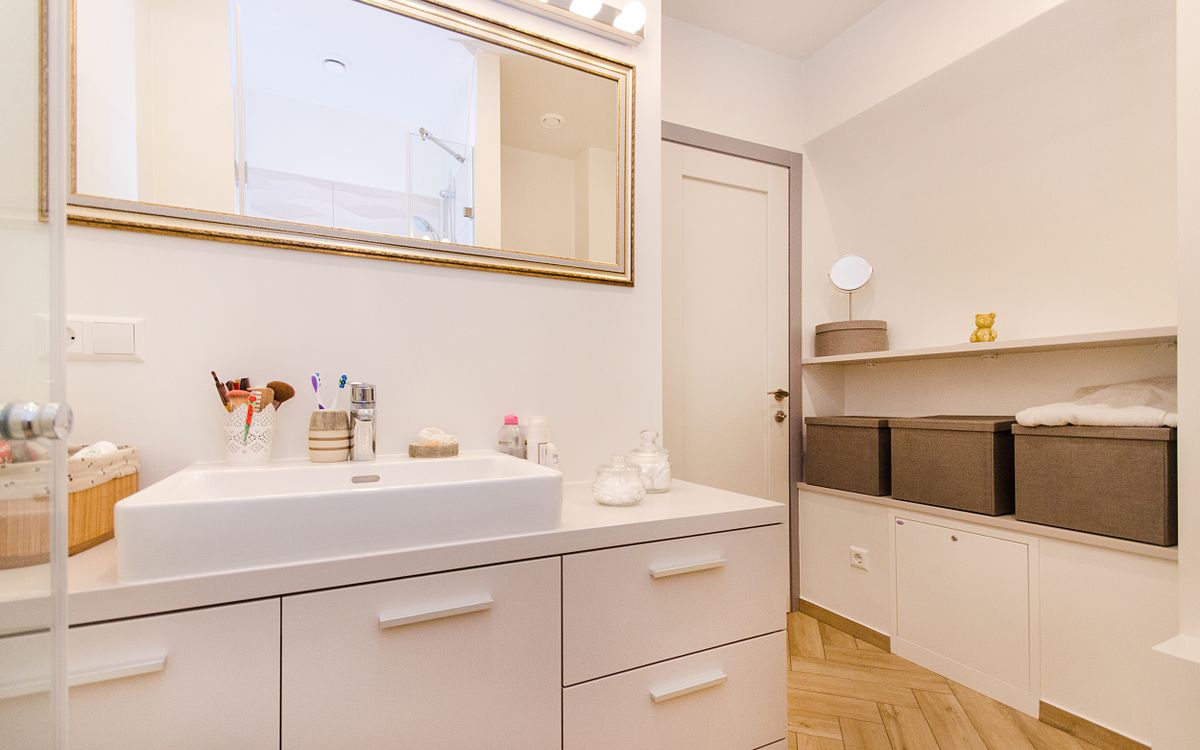
A folded bath towel is a 13-inch object. That one measurement settles most of the argument about linen closet depth, because the shelf has to be at least as deep as the fold and not so much deeper that the space behind the fold becomes a place towels go to be forgotten.
Fourteen inches is the depth that fits that fold with an inch to spare. Eighteen inches is the depth that fits a folded duvet cover and a mattress pad without wrestling them, and it is the depth most people buy for the wrong reason. The question is not which number is bigger. It is which number matches what you actually keep in the closet, and whether the extra depth is reachable once the closet has a door on it.
The folded footprint of a bath towel
A standard bath towel measures about 27 by 52 inches. There are many ways to fold one, but the fold that produces a stackable bundle goes like this: in half across the length, then in half again, giving 27 by 13 inches, then in thirds across the width, giving roughly 9 by 13 inches. The bundle is 2 to 2.5 inches thick.
The long edge of that bundle is 13 inches. That is the number the shelf has to clear. A 14-inch shelf leaves an inch, which is exactly enough for the variation between one towel and the next and for the fact that a fold made in a hurry is never square.
Bath sheets change the arithmetic. The common bath sheet is 35 by 60 inches, and the same fold sequence lands at about 15 inches across. On a 14-inch shelf it overhangs the front edge by an inch, which means the stack leans, the front towel picks up dust from the closet floor, and the shelf above cannot be loaded to the front. If bath sheets are part of the household, 16 inches is the honest minimum and 18 is comfortable.
Hand towels at 16 by 30 inches fold down to about 7.5 inches and washcloths to 6.5. Both will sit two deep on a 14-inch shelf with room between the rows, which is why a linen closet built around bath towels still has useful shallow zones at the ends of each shelf.
Why fourteen is the working number
Fourteen inches is not a standard imposed by anyone. It is where three separate requirements happen to agree.
The first is the fold. Thirteen inches of towel plus an inch of slack.
The second is reach. An average adult forearm is about 10 to 11 inches from the inside of the elbow to the fingertips, and a shelf that a hand can sweep at full depth is a shelf that gets used. At 14 inches, the last towel in the row is still under the fingers. At 18, the back three inches are behind the wrist.
The third is the stack. Four bath towels at 2.25 inches each make a 9-inch pile. With shelves at 12-inch spacing and a 0.75-inch board, the clear gap is about 11.25 inches, which leaves just over two inches of air above a full stack — enough to slide a hand in, not enough to encourage a fifth towel that would rub the shelf above.
The same 14 inches is comfortable for a stack of folded sheets. A queen flat sheet at 90 by 102 inches folds to a bundle that is 14 inches across the fold with five or six layers, and a folded fitted sheet lands in the same range.
Where eighteen inches earns its keep
Eighteen inches is the right depth for a closet that holds bedding rather than towels, and the argument is about how much folding a large item will tolerate.
A queen duvet cover is 88 by 92 inches. Folded to a 14-inch width it needs six folds, produces a bundle 5 to 6 inches thick, and the layers slide against each other while you carry it. Folded to an 18-inch width it needs five, sits flatter, and can be stacked two high without the pile toppling. A king cover at 92 by 104 behaves the same way with one more fold.
A mattress pad or topper is the item that really wants the depth. A queen pad is 60 by 80 inches of quilted fabric with elastic corners, and it does not fold crisply. It rolls, or it folds into a soft lump that is 18 to 20 inches across whatever you do. On a 14-inch shelf it has to be compressed; on an 18-inch shelf it can simply sit.
There is a second, quieter benefit. Eighteen inches is deep enough for two rows of folded goods — a front row you can reach and a back row that holds the spare set. That is a real gain in a closet with limited width, but only if the back row is organised as a small number of large bundles rather than a row of individual towels, because anything in the back row needs to be lifted out in one motion.
Eighteen inches of shelf is not eighteen inches of space
A closet sold or built as 18 inches deep gives you less than that on the shelf, and the gap is bigger than most people expect.
The back panel and the gap behind it take three-quarters of an inch to an inch. A shelf that stops short of the back wall — which is deliberate, to let air move — gives up another inch. If the closet has bypass sliding doors, the track and the door panel sit inside the opening and eat two inches of depth before the shelf begins. A hinged door does not cost depth, but it costs swing, and a shelf loaded flush to the front edge will catch the door.
The practical result: an 18-inch closet with bypass doors has about 15 inches of usable shelf, which is 14 inches plus a margin that disappears as soon as a bath sheet is in the stack. Measure the shelf board itself, front edge to back edge, and then measure the clear distance from the shelf front to the closed door. The smaller of the two is your working depth.
Shelf spacing sets capacity more than depth does
Two closets with the same footprint can differ by a third in what they hold, purely on spacing.
Take a 24-inch-wide closet bay. At 14 inches deep and 12 inches of spacing, the bay offers about 4,000 cubic inches gross. At 18 inches deep the same bay offers about 5,200. But the 18-inch version usually gets built with 14-inch spacing to match its proportions, and that removes a shelf. What is left is fewer, taller, deeper bays that hold bedding well and towels badly, because a 9-inch towel stack in an 18-inch-tall bay wastes the top half.
The usable rule is that depth and spacing should be chosen together and from the contents outward. Towels want 14 by 12. Bedding wants 18 by 16. A closet that has to do both is better with one 18-inch bay at the bottom for bedding and three 14-inch bays above it than with four identical bays that suit neither.
Wire shelves, solid shelves, and what towels need
Wire shelving is common in linen closets because it is cheap and because it lets air reach the underside of whatever is stored. It also leaves a grid pressed into every folded towel, and a towel that has been compressed along a wire line takes longer to fluff back up.
A solid shelf is the better surface for dry linens. It needs two details to work: a gap of about an inch between the back edge and the wall so the closet is not a sealed box, and a front edge that stops slightly short of the door so nothing is pinched when the door closes.
The ventilation question matters more than the shelf material suggests. A linen closet with a solid door, no gap at the back, and shelves loaded to the walls is a small sealed room, and a towel that went in slightly damp will still be slightly damp a week later. If damp towels are a recurring problem rather than a one-off, the fix is a separate drying position rather than a different shelf; how to store towels so they dry covers the airflow side of that in detail.
Choosing for the closet you have
The decision comes down to one inventory question, and a table makes it easier to answer honestly.
| Content | Folded footprint | 14-inch shelf | 18-inch shelf |
|---|---|---|---|
| Bath towel (27 × 52 in) | 13 × 9 in | Fits with 1 in slack | Fits, 5 in unused |
| Bath sheet (35 × 60 in) | 15 × 11 in | Overhangs by 1 in | Fits with 3 in slack |
| Hand towel (16 × 30 in) | 7.5 × 8 in | Two rows deep | Two rows, wide gap |
| Queen duvet cover (88 × 92 in) | 18 × 14 in bundle | Needs a tight extra fold | Fits as folded |
| Queen mattress pad (60 × 80 in) | 18 to 20 in lump | Must be compressed | Sits without force |
If the closet holds towels and sheet sets and nothing else, 14 inches is the answer, and the money is better spent on one more shelf than on four more inches of depth. If it holds duvet covers, mattress pads, or the spare bedding for a guest room, 18 inches is the answer, and the top shelf should be the deep one because bedding is the thing you lift down twice a year.
For a closet that is already built and too deep, the correction is not to fill it to the front. Keep the daily towels in the front 14 inches and put the seasonal bedding behind them in a single large bundle, so the back zone is one object to lift rather than a row to search. The same logic applies at a smaller scale in a bathroom, where the depth that decides whether a shelf works explains why the back of a shelf stops being storage at all.