A closet audit fails for one of two reasons. Either it becomes a sorting session with no end, or it ends with a tidy closet that has the same unusable dimensions it started with. The timing below solves the first problem and the measuring block solves the second.
Sixty minutes, five blocks, one rule: the clock moves you on whether or not the current block feels finished. The measuring block is not optional and it is not moved to next weekend.
The clock is the method, and sixty minutes is the budget
The blocks are sized to the work, not to your enthusiasm.
| Minutes | Block | What must be true when it ends |
|---|---|---|
| 0 to 5 | Clear the floor and photograph the opening | You can stand inside the doorway |
| 5 to 20 | Take everything out, one layer | Every shelf and the rod are bare |
| 20 to 40 | Three piles, decided | Nothing is left in a fourth pile |
| 40 to 50 | Measure the empty closet | Six readings on one sheet |
| 50 to 60 | Write the constraint card, reload | Every kept item has a zone |
The blocks are unequal on purpose. Deciding takes the longest because it is the only part that requires judgement. Measuring takes ten minutes because the closet is empty and a tape measure is fast when nothing is in the way.
Minutes 0 to 5: clear the floor and photograph the opening. Put everything on the floor outside the door, in one move, without sorting it. The floor is the part of a closet that fills first and the part that hides the problem: a foot of bags on the floor has taken the bottom 12 inches of height, and every shelf above it is now doing work the floor should have done.
Then photograph the empty closet from the doorway, with the door open as far as it goes. Two photographs: straight on, and from the side at hip height. The side view is the one that shows how far the door projects into the opening, which is a number you will need in twenty minutes.
If the closet has a light, turn it on. If it does not, use a phone torch for the photograph, because a dark photograph of a dark closet is the reason people measure the wrong wall later.
Minutes 5 to 20: take everything out in one layer
Take everything out and lay it in one layer on the bed, grouped by type as it comes out. One layer matters: stacked items get re-stacked by habit, and the second layer down is where the things you never wear live.
Grouping by type as you go is not sorting, it is counting. Coats go together, shoes go together, the box of cables goes with the other boxes. When the closet is bare you will know how many of each category you own, and that count is what the measuring block converts into shelf space.
Two categories need a container on the bed rather than a place in the layer. Anything that belongs to another room goes straight into a laundry basket — that is the move pile, and it should not be allowed to re-form inside the closet. Anything that is visibly broken goes into a bag, because the out decision for a broken object takes no time and should not consume any of the next twenty minutes.
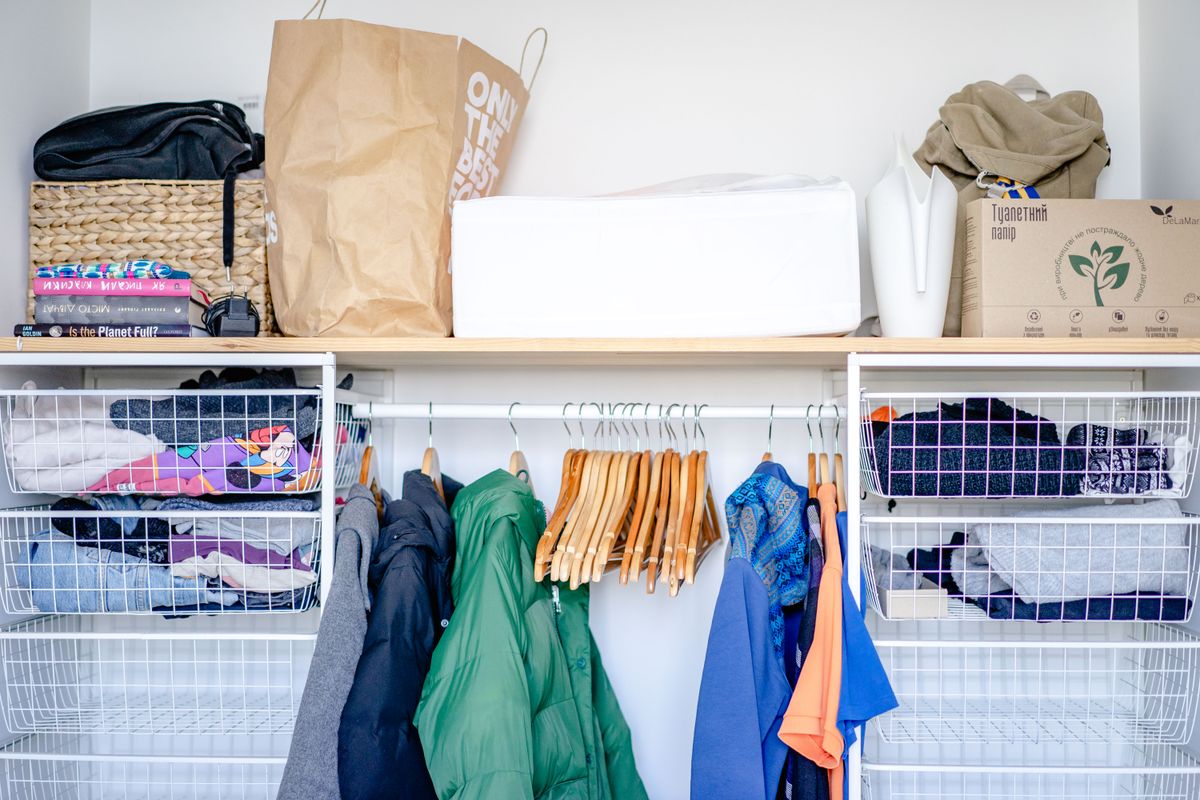
Minutes 20 to 40: three piles, and the rules that keep them honest
Three piles only. A fourth pile called “think about it” is the mechanism by which a closet audit takes three weekends and produces nothing.
Keep requires two conditions, and both are about the closet rather than the object. It has been used since the last seasonal change, and there is a zone in this closet where it can live at the height it needs. An item that passes the first test and fails the second is a move, not a keep — a long coat in a closet whose rod is set for shirts belongs in a different closet, not on the floor.
Move is everything that belongs somewhere else in the house, plus everything that has not been used in a year but is not ready for the out pile. The move pile must physically leave the room at the end of the hour. A move pile that stays becomes floor storage.
Out is donate, recycle or trash, and it gets decided on the spot. Sort it into bags by destination while you are still standing, because a single bag of “out” that sits in a hallway for a month becomes a keep pile with extra steps.
Work in category order rather than in spatial order: all the coats, then all the shoes, then the boxes. Category order is faster because each decision makes the next one easier, and it produces a count per category, which is the number the measuring block needs.
Minutes 40 to 50: measure the empty closet
Six readings, one sheet, and a note beside each one saying where it was taken.
- Inside width, at the top, middle and bottom of the opening, and again at the back. Keep the smallest.
- Inside depth, from the inside face of the back wall to the inside face of the front frame, at left, centre and right. Keep the smallest.
- Clear height of every shelf gap, from the shelf surface to the underside of the shelf above.
- Rod height from the floor, and rod length between its brackets.
- Door width, and how far the door projects into the opening when it is fully open.
- Floor clearance under the lowest shelf, which is where the bags were.
The door reading is the one people skip and the one that constrains the most. A 24-inch door on a 24-inch-deep closet sweeps a quarter circle of 24-inch radius across the front left or right corner, and nothing that has to be reached can live inside that arc. Measure the swing, mark the arc on the floor with a pencil, and treat everything inside it as unavailable.
While the closet is empty, check the rod brackets with your hand. A rod that moves in its bracket under a light pull is a rod that will sag under coats, and the sag is what makes a closet feel full when it is only two-thirds full.
Minutes 50 to 60: turn the measurements into a purchase constraint
The output of the audit is not a tidy closet. It is three numbers that any future purchase has to satisfy.
Width budget. Inside width, minus the door swing zone if the storage is at a height the door crosses, divided by the number of containers you want across, minus a quarter inch of gap between them. A 60-inch shelf with no swing and three bins across gives you 19 3/4 inches per bin, with half an inch left over for the two gaps.
Depth budget. Smallest inside depth minus the lip. On a 24-inch closet with a 3/4-inch back panel and a 3/8-inch frame, that is 22 7/8, and a hanger needs 22 inches of it — which is why a deep closet is mostly hanger, not shelf.
Height budget. Clear height minus 1 inch, so that a lid can open and a hand can reach in. A 12-inch gap gives an 11-inch bin.
Write the three numbers on a card, tape it inside the closet door, and reload the kept items against them. Reloading is the test: any category that does not fit the card is a category that is too large for this closet, and the answer is a move rather than a squeeze. The measurement sequence in the five-step cabinet method is the expanded version of this block, and it is worth running properly the first time.
When the hour runs out with a pile on the bed
Stop at sixty minutes anyway, and photograph the three piles before anything goes back. The photograph is the record of what left, and in a month it is the only way to remember whether the third bag of shoes was donated or moved to the hall closet.
Then apply the one-shelf rule: rather than half-filling three shelves, load one shelf completely against the constraint card, and leave the rest of the closet visibly empty. An empty shelf is a reminder that there is space; a half-filled shelf reads as full, and the floor fills up again within two weeks.
Deal with the remaining piles in the next two days, in this order: move pile out of the room, out pile into the car, keep pile back into the closet. The order matters because the move pile is the one that becomes permanent if it is left alone with the closet it came from.
If the closet’s problem is depth rather than quantity, the audit will show it as more depth than the shelves can use, which is the case covered in linen closet shelving depth. If it is quantity, the audit will show as a pile that is larger than the card can hold, and the five recurring errors in storage mistakes that cost space are the usual reason a closet that measures well still behaves badly.