Pegboard and slatwall are usually compared on looks, which is the one axis where they are closest. The useful comparison is mechanical: how many places a hook can go, how much one hook can hold, what happens to the panel when the garage gets damp, and what it costs to add another bracket two years from now.
Both systems are a panel fixed to a wall with accessories hanging on it. Everything that differs follows from the shape of the hole.
Two grids, one inch and three
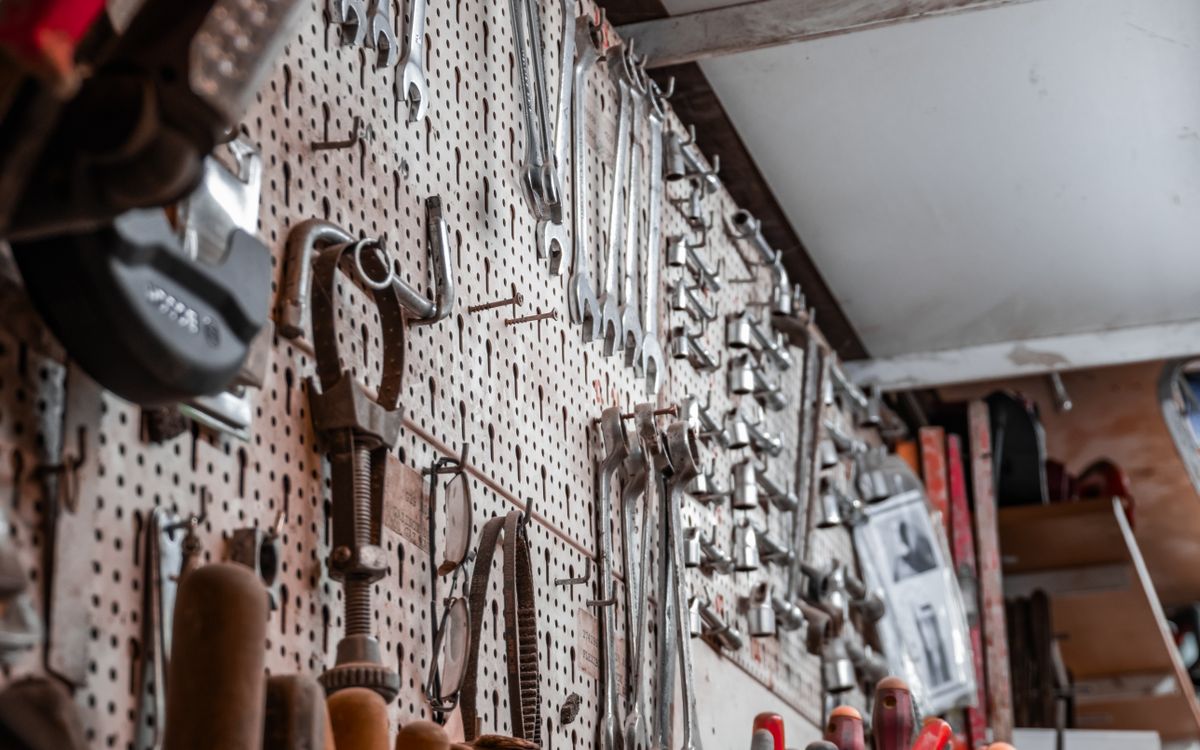
Conventional North American pegboard uses 1/4-inch holes on 1-inch centres, in a 1/8 or 1/4-inch hardboard sheet. The nominal 1/4-inch hole is usually bored at 9/32 inch so that a 1/4-inch peg enters without binding, and 3/16-inch holes and other grid patterns also exist. That variation matters when a hook does not fit: “standard pegboard” describes a convention, not a guarantee.
Slatwall replaces the hole grid with horizontal grooves, most commonly spaced 3 inches on centre. The panel is aluminium, steel, PVC or MDF, and the groove profile is brand-specific. Gladiator states that it does not test other makers’ hardware on its GearWall panels, and Proslat designs its Classic panels for its own accessories. Two hooks that look identical from the front may not seat in the same groove.
So the first difference is resolution. Pegboard gives you a position every inch in both directions. Slatwall gives you a position anywhere along a groove, but only on a groove, and the grooves are 3 inches apart.
Both systems are a panel bolted to studs
Pegboard needs open space behind it, because the hook’s lower tang has to swing back and catch the board. That is why it is mounted on furring strips or spacers: 1/2 to 1 inch of air is the usual gap, and 3/8-inch steel spacers are sold for the purpose. Fix the board to the wall without that gap and the hooks pull straight out under load.
Slatwall does not need a gap, because the groove is the pocket. Panels are typically around 3/4 inch deep — Gladiator GearWall at 3/4 inch, StoreWALL Heavy Duty at about 0.70 inch — and screw directly through the panel into studs, or over drywall into studs, at 16 inches on centre.
That difference in mounting depth has a storage consequence. Pegboard sits about an inch off the wall and steals an inch of floor along its full length; slatwall sits nearly flush. In a garage where a car door opens against that wall, an inch matters.

What the panel rating is worth once a hook is on it
Panel capacities are published in at least three different units, which is why they get misread.
Wall Control rates its steel pegboard at no more than 100 pounds per panel with the supplied drywall anchors, and 200 pounds per panel when fixed into studs or a comparable solid substrate. It separately recommends lower limits for hooks, bins and shelves. Proslat publishes up to 75 pounds per square foot for Classic PVC slatwall on 16-inch stud centres. Gladiator publishes 50 pounds per square foot for GearWall. StoreWALL publishes up to 300 pounds per square foot at the panel surface for its Heavy Duty panels on reinforced InstallStrips, and its own documentation shows capacity falling as the load moves away from the wall.
Those numbers are not a ranking. A per-panel figure and a per-square-foot figure cannot be converted into each other without knowing the test method, and a hook holding a load 4 inches from the wall puts far more torque on the groove than the same weight hanging flat against the panel. The lowest applicable limit — panel, hook, bracket or framing — is the one that governs.
For scale, a 4-by-8 panel is 32 square feet. At 50 pounds per square foot that is 1,600 pounds of panel capacity, which sounds enormous and is almost never the binding constraint. The binding constraint is usually one hook with a 40-pound tool bag on it.
Mounting density: positions per square foot
Resolution is the clearest mechanical difference, and it is easy to count.
A 2-by-4-foot pegboard panel is 8 square feet of nothing but positions: 48 columns by 24 rows at 1-inch centres, which is 1,152 holes, or 144 per square foot. The same area of slatwall at a 3-inch pitch has 8 grooves across its 24-inch height and none across its width, which works out at 4 grooves per square foot, each one continuous along the panel’s length.
In practice the pegboard number is what makes the format work for tools. A wrench set wants hooks 2 inches apart at the same height; a socket rail wants six hooks on one line; a level wants two hooks exactly at its ends. On a 1-inch grid all three are possible without moving the panel. On a 3-inch pitch you are placing along one axis only, and the vertical position of every hook is fixed by where the groove is.
Slatwall wins that axis back with accessories. Shelf brackets, wire baskets, tray bins and J-hooks all engage a groove and can be slid along it, and a shelf on two brackets can hold items that no hook would. If your wall is a set of categories rather than a set of shapes — bins of rags, a shelf of aerosols, a basket of gloves — the coarse grid is not a limitation.
Single-hook load: the number nobody publishes
This is the figure that decides most garage walls, and it is the one most often missing from the listing.
Pegboard hooks are rated individually. A locking single-rod hook for 1/4-inch pegboard on 1-inch centres, from a commercial hardware supplier, is listed at 15 pounds. That is a realistic figure for a hook whose only engagement with the panel is a wire tang behind a quarter-inch board. Standard hooks without the locking wire carry similar loads and fall out when the item hanging on them is lifted at an angle, which is why locking hooks are worth the small premium.
Slatwall accessories are usually rated by the panel rather than the piece, and the honest answer for a specific hook is often that the maker does not publish one. What can be said is the mechanism: a slatwall hook engages a formed lip along the full width of its back plate and sits in a 3/4-inch-deep channel, so it resists the peel-out that limits a pegboard hook. It also holds the load further from the wall, which is the trade.
Both systems share one limit that no panel rating captures: the fastener. A 200-pound-per-panel rating assumes screws into studs. Through drywall alone it drops to the 100-pound figure, and on a wall with no studs where you need them it drops to whatever the anchors can take.
Dust, damp and the gap behind the panel
A garage is a wet room that happens to have a car in it. Humidity swings, road salt, and a concrete slab that holds moisture all year.
Pegboard’s material is the problem. Standard pegboard is hardboard, a wood-fibre panel, and wood fibre takes on moisture, swells at the holes and the cut edges, and does not fully recover. Factory-tempered board resists this better than untreated board, and paint on both faces and all four edges is the cheapest protection available. Coated steel pegboard panels sidestep the issue entirely and are usually sold on that basis.
The gap behind pegboard collects dust, and there is no good way to clean it without taking the panel down. It also hides the wall, so a slow leak or a stain from the roof will not be visible until it reaches the panel face.
Slatwall’s grooves collect dust too, but they are open to a brush. PVC and steel panels do not swell. The steel fasteners and the hooks in either system still rust, and so do the tools hanging on them, which is a reason to keep the wall ventilated rather than to choose one panel over the other.
What it costs to extend the wall later
The purchase price of the panel is the smallest part of this decision over five years. The accessory pool is the rest.
Pegboard’s advantage is that its accessories are a commodity. Any 1/4-inch hook fits any 1-inch pegboard, from any hardware store, for a few dollars, and the format has been unchanged since the 1950s. You can add a hook for a new tool without thinking about the brand of the panel, and you can move it a hundred times.
Slatwall locks you to a profile. Gladiator states it does not test other makers’ hardware on GearWall, and Proslat designs its panels for its own accessories; StoreWALL’s system depends on its InstallStrips. That is not a defect — it is how the higher per-hook capacity is achieved — but it means the accessory range you buy into is the range you live with, and that bins and brackets cost more per position than hooks do.
The cost curve therefore crosses. For a wall of hand tools that will keep growing, pegboard is cheaper to start and cheaper to change. For a wall of bins and shelves holding heavier things, slatwall’s per-position cost is higher but you need fewer positions.
Which wall gets which
The decision is usually not one or the other, because a garage has two kinds of wall.
The wall by the bench, where tools hang and the layout changes, suits pegboard: maximum positions, cheap hooks, and a grid fine enough to put a level’s two hooks exactly where the level’s holes are.
The long wall, where bins, baskets and shelves go and nothing gets rearranged, suits slatwall: fewer positions, higher per-position capacity, flush mounting, and a surface that shrugs off damp.
If you are building the wall from scratch, the load question comes before the panel question, because both systems are only as good as the framing behind them. The bracket side of that is set out in garage wall shelving load ratings, and anything going above head height has its own set of limits in overhead garage storage safety.
Choose on the shape of what you hang. A wall of tools wants resolution. A wall of containers wants capacity. Buying the higher-rated panel for a wall of screwdrivers spends money on a figure you will never reach, and buying the finer grid for a wall of 40-pound bins reaches a limit on the first hook.