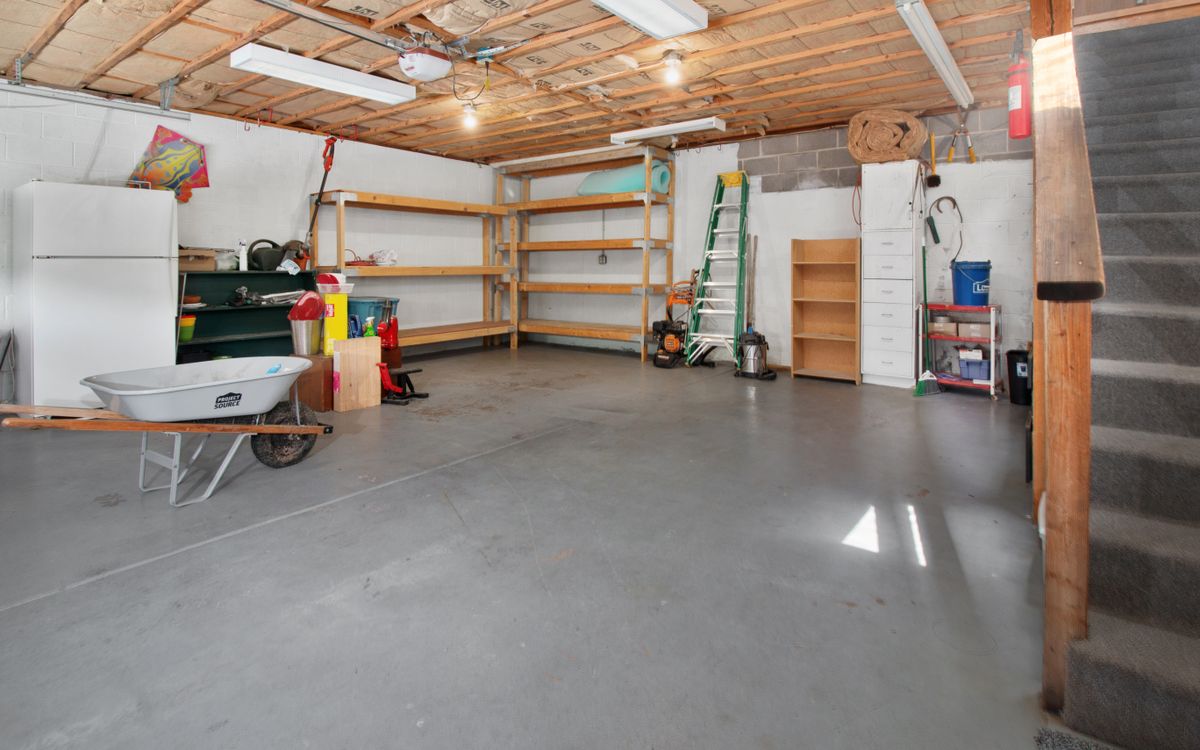
Floor stacking is the storage method of last resort in a garage, and it is also the one with the fewest published numbers. Shelving comes with a load rating, brackets come with a load rating, and a tote comes with a capacity in gallons that tells you nothing about how many of them you can put on top of each other.
There is a real answer, but it comes from two different published figures and one piece of geometry. This piece takes three totes that are actually sold for garage floors, reads what their makers publish, and works out how tall each column can stand.
A floor stack fails in one of three ways
Before comparing products it is worth separating the failure modes, because they are limited by different numbers and a stack is only as good as its weakest one.
The first is crush. The bottom tote carries the weight of everything above it, transmitted through the lid rather than through the walls. A lid is a flat panel spanning an opening, so it deflects in the middle, and the deflection is permanent once the polymer creeps. A crushed bottom tote is not a tote that broke; it is a tote whose lid has taken a set and will no longer seal.
The second is latch failure. The latches hold the lid to the base, and they are the thinnest sections in the whole assembly. When a lid bows, the latch tabs are levered outward, and a tab under load in cold weather is the classic point of failure. This is also why an overloaded stack tends to fail at the second tote from the bottom rather than the first: the bottom one is supported by the slab, and the one above it is the first to be squeezed between a load and a deflecting lid.
The third is tipping, which has nothing to do with the polymer and everything to do with height against footprint. A column of totes is a rigid box on a base, and it goes over when its centre of gravity passes beyond the edge of that base.
The three numbers on a tote, and which one you can trust
A tote listing gives capacity in gallons, sometimes an outside dimension set, and sometimes a load figure in pounds. Only the last one is a rating in the sense that a shelf bracket rating is a rating, and even then it needs reading.
Capacity in gallons is a volume and says nothing about load. A 27-gallon tote full of packing peanuts and a 27-gallon tote full of tile weigh wildly different amounts, and both are “full”.
The load capacity is what one tote is rated to hold. It is stated per container, on the assumption that the container is being carried or stacked within its maker’s guidance. It is not the answer to “how much can the bottom one carry”.
The stack quantity is the number that actually answers the question, and it is the one almost no consumer tote publishes. Akro-Mils publishes it for its attached-lid line, as a plain number on the specification chart: a stack capacity, expressed as a maximum count of containers stacked on a closed lid.
Where a maker publishes neither, the tote is not rated for unlimited stacking; it is simply unrated, and the working limit has to be found by loading the bottom unit and watching the lid seam for the point where it stops being straight.

Akro-Mils 39120 Attached Lid Container: 12.5 inches, five high
The shortest of the three and the one with the most stack height per inch of footprint. Outside it measures 21.5 × 15.25 × 12.5 inches, with inside dimensions of 19.75 × 14.1875 inches at the top and 17.875 × 12.375 inches at the bottom, which is 12 inches of interior height and 12 gallons of volume.
Akro-Mils publishes two figures that matter here: a 65-pound capacity and a stack quantity of five. Five times 12.5 inches is a 62.5-inch column, and the bottom container is carrying four loaded containers above it — 260 pounds, transmitted through its lid.
That is a lot to ask of a lid, and it is worth being precise about what the number does and does not promise. The stack quantity is the maker’s tested configuration for its own containers at its own rated load. It is not a statement that the bottom lid will stay flat, only that the assembly is rated to stand that way. Treat it as a ceiling and load lighter than the rating.
The design details that support the number are the ones to look for on any tote: an attached lid on reinforced hinge pins so the lid cannot be lost or mis-seated, a lid that closes onto a rim rather than resting on it, and a textured or ribbed base that grips the lid below. The padlock eye on both ends is a security feature, not a structural one, but it does mean the latches are moulded thick enough to drill.
The limitation is the shape. Twelve inches of interior height will not take a five-gallon bucket, a jerry can standing up, or most filled paint rollers, and the 12-gallon volume fills quickly with anything bulky. This is a container for dense, small, heavy things: fasteners, hand tools, small power tools, bottled fluids.
Sterilite 27 Gal. Industrial Tote: the tall middle with no rating
The volume option. Outside dimensions are 30.5 × 20.625 × 15.25 inches, and the interior at the bottom measures 24.75 × 15.75 × 14.375 inches, which is the figure that matters because the walls taper outward toward the top and the loaded footprint is the bottom one.
Sterilite does not publish a load capacity for this tote, and its published stacking guidance is the sentence that appears across its industrial line: use good judgement when stacking, and keep the heaviest bin at the bottom. That is honest, and it is not a number. What the product page does specify is a recessed lid, which captures the base of the tote above it, and channeled walls, which the maker describes as resisting crushing under heavier loads.
The recessed lid is the feature that matters most for a floor column. A flat lid on a flat rim depends entirely on friction, and a stack of them walks out of alignment when someone brushes past. A well in the lid seats the base of the tote above and the column stays plumb without straps.
The trade is the footprint. At 30.5 by 20.625 inches this tote occupies 4.4 square feet of floor, against 2.3 for either Akro-Mils container. Two of these side by side use as much floor as four of the smaller ones, so the 27-gallon size only makes sense where the floor is genuinely free and the contents are bulky and light — decorations, bedding, empty luggage, winter coats.
Without a published stack quantity, the limit is the flex test. Load the bottom tote to what you intend to carry, look along the lid seam from the side, and stop adding totes when the line stops being straight. On this tote, with a recessed lid, that typically happens at three or four high rather than five, because the internal volume means most people fill it to 40 or 50 pounds and the span across 24 inches of lid is longer than the span across 19.
Akro-Mils 39170 Attached Lid Container: 17 inches, three high
The tall container, and the clearest illustration that stack quantity and load capacity pull in opposite directions.
It shares the footprint of the 12.5-inch container — 21.5 × 15.25 inches outside, the same 19.75 × 14.1875 at the top and 17.875 × 12.375 at the bottom — and adds height, at 17 inches outside and 17 gallons of volume. Capacity is 100 pounds, higher than the shorter container’s 65. Stack quantity is three, lower than the shorter container’s five.
So the taller container holds more per container and less per column. Three high is 51 inches, and the bottom container carries two loaded containers above it, or 200 pounds. The shorter container carries 260 pounds at the bottom of a 62.5-inch column.
The reason is geometry. A taller container puts the load further above the lid below it, so the same weight arrives with more leverage, and the walls of the container above act as a longer lever on the lid below. It is the same relationship that makes a deep shelf bracket weaker than a shallow one.
Seventeen inches of interior height is what you want for anything that has to stand: a five-gallon bucket with a lid, a coil of hose, a full watering can, tall bottles, a strimmer with the shaft detached. It is also the container that makes a stack visible from the far end of the garage, because three of them reach chest height and the top lid is a shelf in its own right.
The caution is mixing. A 17-inch container sitting on a 12.5-inch container is the same footprint but not the same rating, and the taller one has the higher centre of gravity. If you mix the two, put the tall ones at the bottom and stop the column at whatever the lowest-rated container allows.
| Model | Capacity | Outside height | Rated load | Stack quantity | Column height |
|---|---|---|---|---|---|
| Akro-Mils 39120 | 12 gal | 12.5 in | 65 lb | 5 | 62.5 in |
| Sterilite 27 Gal. Industrial Tote (1466) | 27 gal | 15.25 in | not published | not published | flex test |
| Akro-Mils 39170 | 17 gal | 17 in | 100 lb | 3 | 51 in |
The height budget: 62.5 inches against 51
A stack has to fit under the ceiling as well as inside its rating, and the two numbers rarely agree.
A typical garage ceiling is 8 feet, or 96 inches, with a 7-foot door leaving about 12 inches of headroom above it. A 62.5-inch column leaves 33.5 inches of clearance under an 8-foot ceiling, which sounds generous until you remember that you have to lift the top container off and that a loaded 12-gallon container weighs up to 65 pounds.
Working height, not ceiling height, is the limit. Anything above about 60 inches requires lifting a loaded container to chest height and then over the lip of the one below, which is where backs go. A 62.5-inch column is at the edge of that; a 51-inch column is comfortable for most adults; a four-high stack of the 15.25-inch Sterilite is 61 inches, which is the same edge.
Two practical adjustments follow. If the column must be tall, load the upper containers lighter than the lower ones — the opposite of what the “heaviest at the bottom” rule sounds like, and consistent with it, because the bottom container’s job is to carry, not to be convenient. And keep a step stool within reach of the stack, because the alternative to a stool is a stretch, and a stretch on a loaded lid is how stacks go over.
Stability, not just crush: the footprint rule
The tote ratings say nothing about tipping, and tipping is what actually happens to a column in a garage.
A uniform column goes over when it tilts far enough that its centre of gravity passes beyond the edge of its base. For a column of height H on a base of width W, that angle is the arctangent of W divided by H. Run the numbers on these three and the difference is stark.
A 62.5-inch column on a 15.25-inch base tips at 13.7 degrees. The same base under a 51-inch column tips at 16.6 degrees. The Sterilite’s wider 20.625-inch base under a 61-inch column tips at 18.7 degrees. Every one of those angles is small enough that a car door, a ladder or a person carrying something can supply it.
That is the argument for keeping the column against a wall, and it is also the argument for not exceeding the published stack quantity even when the lid looks fine. The lid is holding; the geometry is the part with no margin.
The floor matters here too. Garage slabs are poured with a fall toward the door, commonly around 1/8 inch per foot, and a slab that also has a control joint or a spalled patch is not a level base. A stack across a joint will lean, and a leaning stack has already spent part of its tip angle. Site the column on the flattest continuous patch you have, and shim the bottom container rather than the top one.
What the stack does over three winters
Cold changes the failure mode rather than the load, and the change is worth planning for.
The polymer itself is rarely the problem. The materials used for a container sold for garage and jobsite duty stay serviceable well below freezing, which is why a tote left out in January is still a tote in February. What cold does is remove the small amount of give that was absorbing misalignment. A lid that was quietly flexing by a sixteenth of an inch in July has no flex left at 20°F, and the latch tab takes the difference.
Thermal cycling compounds it. A stack loaded in summer expands and settles; the same stack at 10°F contracts, and the latches that were snug are now carrying load in a direction they were not seated for. Over three seasons the effect shows up as latches that no longer snap, lids that sit proud on one corner, and a bottom container with a permanent dish in its lid.
Three habits make the difference. Keep the total under the published stack quantity rather than at it. Unload and reload the column once a year rather than adding to the top of it, which redistributes the creep. And keep cardboard out of the bottom layer, because a cardboard box on a concrete slab wicks moisture and collapses, taking the column’s alignment with it.
If the containers are going onto shelving rather than the floor, the load path changes completely and the wall becomes the limiting part; garage wall shelving load ratings covers that side. For what the plastic itself does at low temperature, including why the latch is the part that fails, clear bins that survive a cold garage goes through the material question in detail.
The shortlist
For the most storage in the least floor space, the Akro-Mils 39120 Attached Lid Container is the one to start with: 12 gallons on a 2.3-square-foot footprint, a published 65-pound capacity, and a published stack quantity of five. It is the only one of the three where the column height is a stated number rather than a judgement call, and 62.5 inches is as tall as a floor stack should get.
For bulky, light contents and a wall that needs to look like one system, the Sterilite 27 Gal. Industrial Tote (1466) is the volume answer. The recessed lid holds a column in alignment better than a flat one, the 27-gallon interior takes things no 12-gallon container will, and the absence of a load rating means you supply the discipline: three or four high, flex test at every layer.
For anything that has to stand upright, the Akro-Mils 39170 Attached Lid Container is the only one of the three that will do it, at 17 inches of interior height and a 100-pound capacity. Stack it three high and no higher, and put it at the bottom if you are mixing sizes.
In all three cases the measurement to take before buying is not the tote. It is the ceiling height above the flattest patch of floor you have, minus the working height you are willing to lift to.