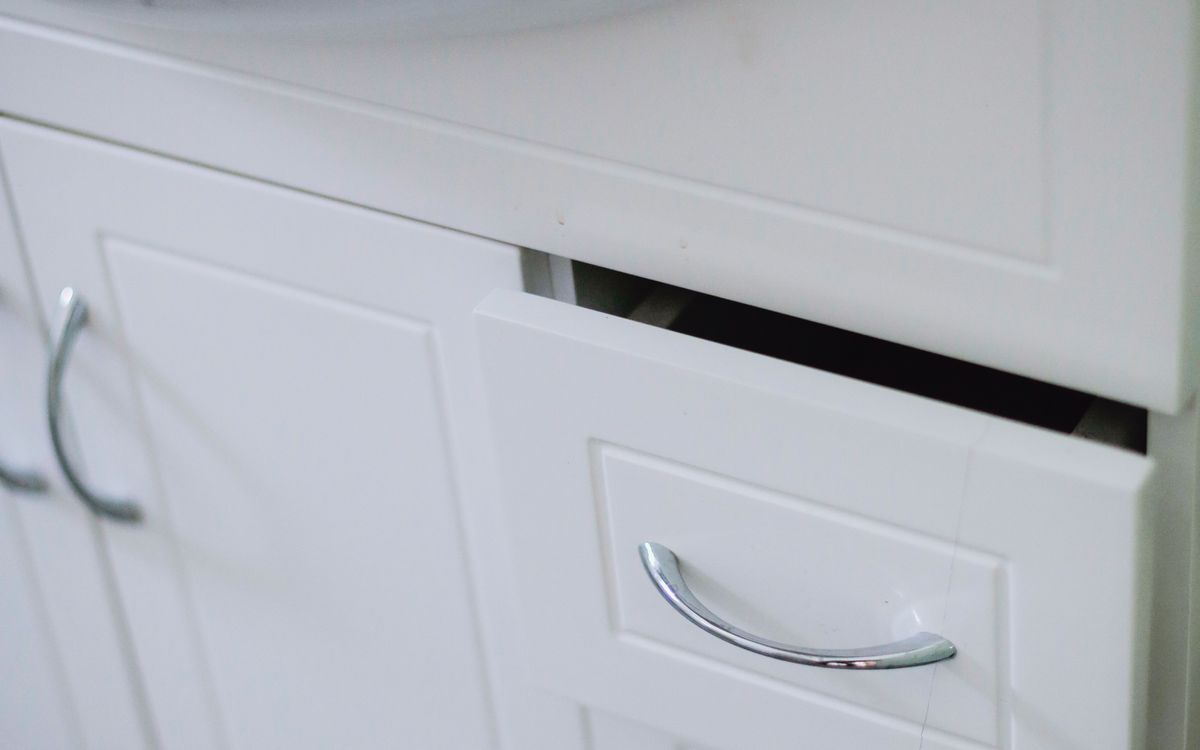
Before you can buy a drawer organizer you need one number, and it is not the one printed on the vanity. It is the inside width of the drawer box, and on a typical bathroom vanity it is 2 inches narrower than the cabinet it came in. On a face-frame cabinet it can be 4 inches narrower.
The arithmetic is worth doing on paper, because it runs in one direction only. Cabinet width minus the cabinet sides gives the clear opening. The opening minus the slide clearance gives the drawer box. The box minus its own walls gives the space a tray can occupy. Each step loses between a quarter inch and an inch, and the losses compound differently at 12, 18 and 24 inches.
Nominal width is not the width you have
A vanity sold as 18 inches wide is 18 inches across the outside of its cabinet box. Inside, the two sides take up space, and on a frameless cabinet those sides are usually half-inch panel, so the clear opening is 17 inches.
Two more deductions sit between that opening and the drawer. The first is slide clearance. Standard side-mount ball-bearing slides need about half an inch on each side, one inch in total, so a drawer box built for a 17-inch opening is 16 inches wide outside. Undermount slides need far less, often around three-eighths of an inch in total, which is why the same cabinet can hold a wider box if it was built with undermounts.
The second is the drawer’s own walls. Half-inch sides are standard for vanity drawers, so an inch comes off the outside width to give the inside width. A 16-inch box has 15 inches inside.
That is two inches of loss from nominal, before a face frame is involved. On a face-frame cabinet the drawer opening is framed by stiles, typically 1.5 inches wide on each side, so a nominal 18-inch cabinet can present a 15-inch opening and a 14-inch box. This is the single largest source of returned organizers, and it is entirely predictable from a tape measure.
The 12-inch cabinet: 11 inches of opening, 9 inches inside
A 12-inch cabinet is the narrow base often used beside a sink or as a filler cabinet in a small bathroom. Frameless, it works out as follows.
| Step | Dimension |
|---|---|
| Nominal cabinet width | 12 in |
| Clear opening (half-inch sides) | 11 in |
| Drawer box outside width (side-mount slides) | 10 in |
| Inside width (half-inch box walls) | 9 in |
| Usable tray width with quarter-inch play | 8.75 in |
Nine inches inside is enough for two columns of small items or one column of taller ones. In practice that means either two 4-inch trays side by side with half an inch to spare, or a 3-inch tray and a 6-inch tray, or a single 9-inch tray run front to back as a divided cutlery-style insert.
What does not work is any tray sold as a 12-inch organizer. The nominal width in an organizer listing usually refers to the outside of the tray, and a 12-inch tray in a 9-inch drawer is a return. Look for the tray’s own outside dimension and add a quarter inch of clearance on each side, because a tray that fits exactly will jam the moment the drawer box swells in a humid bathroom.
A face-frame version of the same cabinet is tighter still: 9 inches of opening, an 8-inch box, and 7 inches inside. At 7 inches you are down to a single narrow tray or a loose arrangement of small bins, and a purpose-made insert is usually a better buy than a modular system.
The 18-inch cabinet: the comfortable middle
Eighteen inches is where a bathroom drawer starts to be genuinely useful, because it is the first width that takes a full row of bottles lying down or two rows of small items.
| Step | Dimension |
|---|---|
| Nominal cabinet width | 18 in |
| Clear opening (half-inch sides) | 17 in |
| Drawer box outside width | 16 in |
| Inside width | 15 in |
| Usable tray width | 14.75 in |
Fifteen inches inside divides cleanly into three 5-inch columns, or a 6-inch and a 9-inch, or a 15-inch tray that fills the drawer edge to edge with a quarter inch of play. The 3-inch increment is the reason this width is easy to plan: almost every modular tray line is built in 3-inch steps from 3 to 18 inches, so 15 inches is five units of three.
Depth is where an 18-inch cabinet earns its keep. A vanity cabinet is commonly 21 inches deep front to back, and the drawer box inside it runs 16 to 18 inches because the slides come in 2-inch steps and need about an inch of clearance behind. Sixteen inches of box depth minus an inch for the front and back walls leaves 15 inches of inside depth, which takes a 12-inch bottle standing upright with room to close the drawer and a 15-inch tray with nothing to spare.
The 24-inch cabinet: two rows, or one long one
Twenty-four inches is the widest drawer most people have in a bathroom, and it changes what the drawer is for rather than just how much it holds.
| Step | Dimension |
|---|---|
| Nominal cabinet width | 24 in |
| Clear opening (half-inch sides) | 23 in |
| Drawer box outside width | 22 in |
| Inside width | 21 in |
| Usable tray width | 20.75 in |
Twenty-one inches inside will take three 6-inch columns, or a 9-inch and two 6-inch, or a single 21-inch tray. It also takes two rows of shallow trays front to back in a 15-inch-deep box, which is a different layout rather than a bigger one: a row of 6-inch-deep trays at the back and a row of 9-inch trays at the front, each accessible by sliding the drawer out.
One caveat applies to the sink cabinet specifically. On a 24-inch vanity with a sink, the top drawer front is usually fixed, because the sink bowl occupies the middle of the cabinet and needs 5 to 8 inches of depth below the counter. The drawers that actually pull out start below the bowl, and they are often 6 inches narrower than the cabinet because the bowl and its supply lines take the rest.
Depth is the dimension the divider kits ignore
Almost every organizer listing leads with width and height and buries depth, which is the number that decides whether the drawer closes.
Two deductions apply. The drawer box’s front and back walls take about an inch of the box depth, so a 16-inch box gives 15 inches inside. And the tray itself has a depth, which has to be less than that inside figure if you want the drawer to shut without the tray sliding forward into the front panel.
Bathroom drawer boxes commonly run 16 to 18 inches deep in a 21-inch cabinet, with slides in 10, 12, 14, 16, 18, 20 and 22-inch lengths. Modular trays are commonly sold at 12, 15 and 18 inches deep for exactly this reason. A 12-inch tray in an 18-inch box leaves 6 inches of unused depth, which sounds wasteful until you realise it is the space where tall bottles stand upright behind the tray.
That is the arrangement worth planning for: shallow tray at the front for small items, open depth at the back for bottles. It uses the full drawer and it keeps the bottles from falling over every time the drawer is opened.
Height: a 5-inch drawer is not 5 inches inside
Bathroom drawer boxes are commonly 3, 5 or 6 inches high, and the usable height inside is roughly three-quarters of an inch less than that once the bottom panel and its groove are accounted for.
That makes a 3-inch drawer a 2.25-inch drawer, which is a razor-and-tube drawer and nothing else. A 5-inch drawer gives about 4.25 inches inside and takes a standing toothpaste tube or a jar of cream. A 6-inch drawer gives about 5.25 inches and is the smallest height that will take a full-size bottle of mouthwash lying on its side without the cap fouling the counter above.
Stacked dividers cost height. A two-tier insert inside a 5-inch drawer leaves about 2 inches per tier, which is shorter than most pump bottles. If the drawer is 5 inches or less, use a single-tier tray with movable dividers rather than a stacking system.
Measure the drawer, not the cabinet
The routine takes three minutes and it removes every guess from the purchase.
Open the drawer and measure the inside width between the two side walls at the front, at the middle and at the back. Take the smallest of the three. Drawer boxes are rarely square, and a quarter inch of difference between front and back is normal in a factory box.
Measure the inside depth from the back of the front panel to the inside of the back panel, then measure the inside height from the drawer bottom to the underside of the side wall’s top edge. If the drawer has a fixed divider or a cut-out for the sink trap, measure the largest clear rectangle rather than the whole drawer.
Finally, check what the drawer is. Pull it all the way out and look at the slides: if the box is 20 inches deep but the slides are 16 inches, the back 4 inches of the drawer is overhanging and anything heavy placed there will tip the drawer when it is open. Tray placement follows the slides, not the box.
The same arithmetic runs through the whole house, which is why the twelve-inch rule applies to drawer depth as well as shelf depth, and why measuring a cabinet for inserts starts with the opening rather than the box. If the drawer you are fitting is in a medicine cabinet rather than a vanity, the constraints are tighter and medicine cabinet organizers covers them.